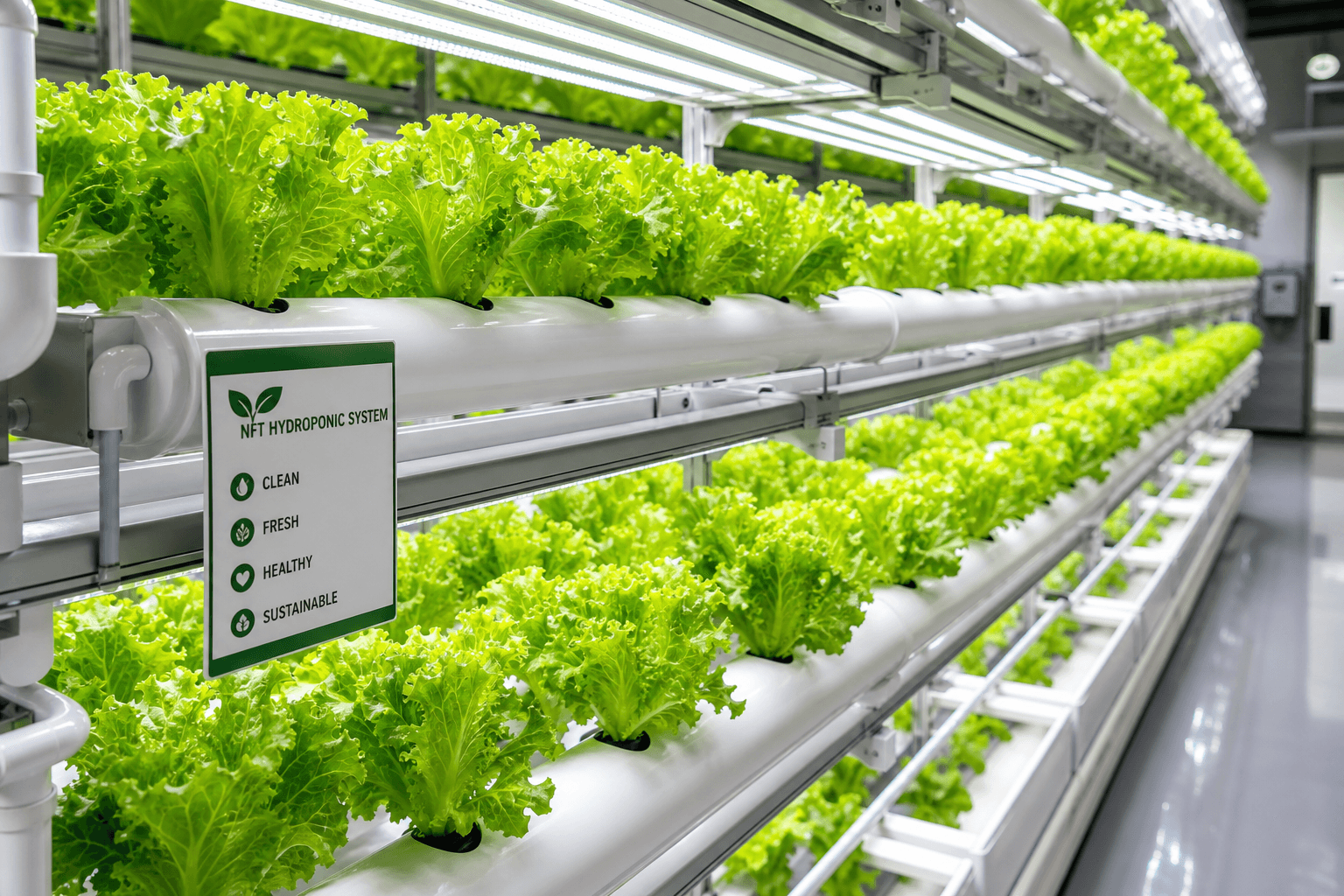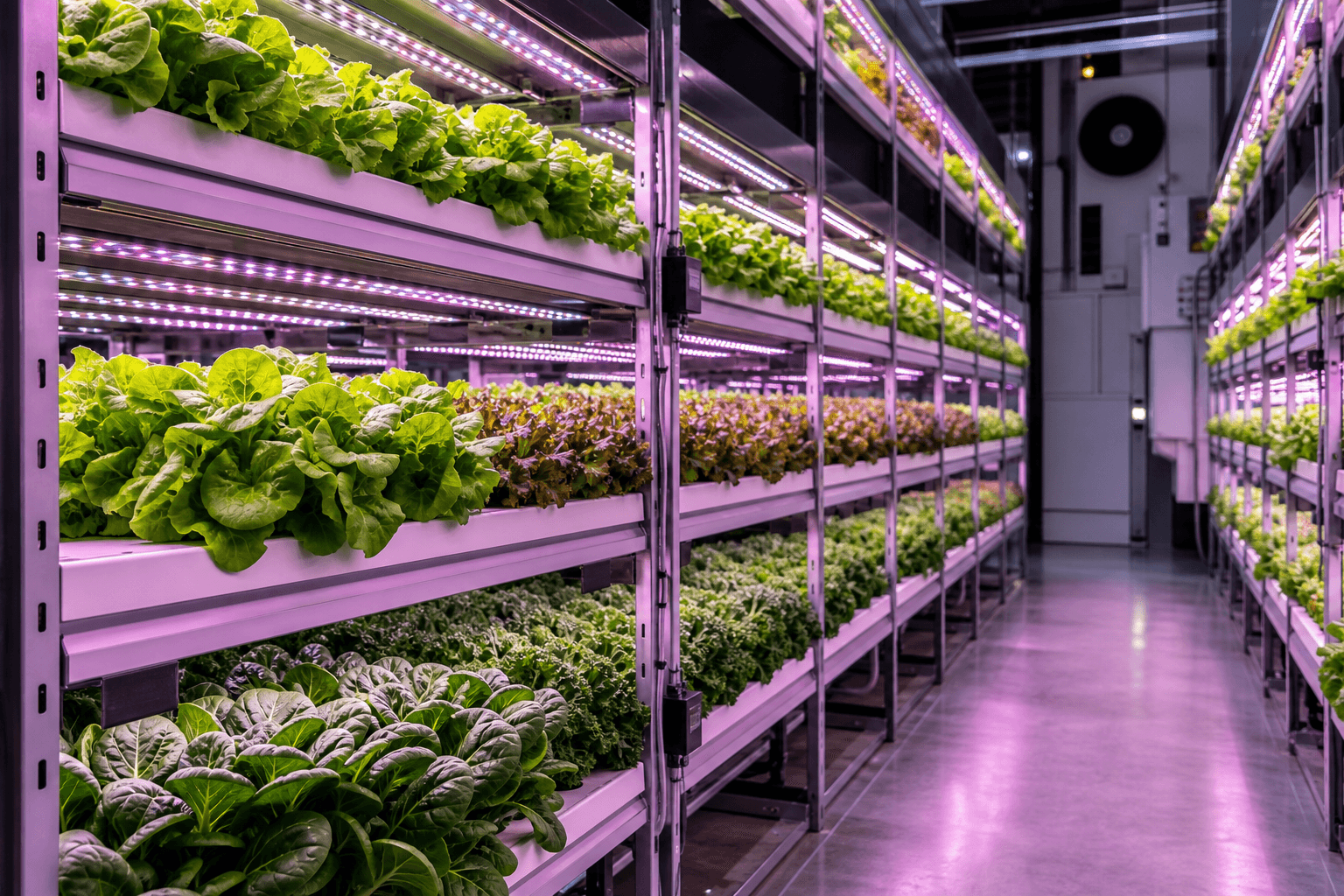
Vertical farming — growing crops in stacked layers inside a controlled environment — has moved from a Silicon Valley curiosity to a serious option for Indian entrepreneurs who want year-round production near cities. You do not need 10 acres in a rural block; a warehouse floor or a repurposed industrial shed can hold thousands of plants on vertical racks.
But vertical farming is also one of the most misunderstood topics in modern agriculture blogging. Vendor brochures promise crore-scale revenues; critics call it a power bill with lettuce attached. This guide sticks to sourced numbers from our 2026 research compendium and tells you where subsidy help exists, where it does not, and how vertical farming compares to hydroponics and protected cultivation on open land.
What Vertical Farming Means in the Indian Context
In India, "vertical farming" usually refers to indoor or semi-indoor stacked cultivation — often hydroponic or aeroponic — where plants grow on multiple tiers under artificial lighting. It is distinct from a naturally ventilated polyhouse, which uses sunlight through UV-stabilised polyfilm and costs roughly ₹25–40 lakh per acre before subsidy.
Vertical systems trade free sunlight for control. You manage temperature, humidity, light spectrum, and nutrient delivery precisely. That control enables 30–50% faster growth in hydroponic setups (a figure commonly cited alongside soil comparison data) and 90% less water than field farming — but you pay for it in capital expenditure and electricity.
Leading Indian players in the space include UrbanKisaan and Ninjacart, both of which have built supply chains connecting controlled-environment produce to urban consumers. Their existence confirms market demand; it does not guarantee your unit will profit on day one.
Setup Costs — From Starter Units to Commercial Scale
Vertical farm economics depend heavily on scale. Sourced cost ranges:
| Scale | Indicative setup cost |
|---|---|
| Small / pilot unit | From about ₹8 lakh |
| Commercial (NIAPER-cited) | ₹50 lakh – ₹1 crore per acre equivalent |
| Large automated facility | More than ₹1 crore |
These figures include racking, grow lights, HVAC, irrigation/nutrient systems, and building retrofit — not land cost in prime urban locations, which can exceed the equipment bill.
Compare this with commercial hydroponics at 1 acre: ₹70 lakh – ₹1.5 crore for a basic NFT or deep-water-culture setup, or ₹5–10 lakh for entry-level kits. Vertical farming sits at the upper end because stacking adds structural, lighting, and airflow complexity.
Income claims for vertical and hydroponic farming are frequently vendor-optimistic. Present upper-bound revenue scenarios — such as ₹2–3 crore gross per year from high-value crops on 1 acre — as possibilities that depend on market contracts, utilisation rate, and energy costs, not as guaranteed returns.
Operating Costs — Energy Is the Elephant
Once the system is running, energy can consume up to 40% of operating expenses. LED grow lights run 12–18 hours daily; dehumidifiers and fans run continuously; pumps circulate nutrient solution through every tier.
Additional annual operating costs cited for commercial vertical acre-equivalent units: ₹5–10 lakh per acre per year beyond energy — covering nutrients, labour, packaging, maintenance, and marketing.
Before you sign a lease on a city warehouse, model electricity at your state's commercial tariff. Pairing the facility with rooftop or ground-mounted solar under PM-KUSUM can improve margins, though indoor vertical farms may not have the land area Component A requires (4–5 acres per MW within 5 km of a substation). Component B solar pumps help if any part of your operation moves to a rural greenhouse.
Best Crops for Vertical Farms
Crop choice makes or breaks the model. Vertical farms excel where:
- Growth cycle is short (harvest in weeks, not months)
- Value per kilogram is high
- Transport and shelf life favour local sale
- Plant height stays ** manageable** on stacked racks
Leafy Greens and Microgreens
Lettuce, spinach, kale, and microgreens are the default vertical crops globally. In hydroponic comparison data, 1 acre of lettuce can yield 300–400 tonnes per year versus 9–10 tonnes in soil — but that figure applies to horizontal hydroponic greenhouses as well as vertical stacks. Microgreens command premium restaurant prices with harvest in 7–14 days.
Herbs
Basil, coriander, mint, and specialty herbs fit vertical racks well. Restaurants and organised retail pay for consistency — exactly what controlled environments deliver.
Strawberries
Strawberries are increasingly grown in vertical and protected systems. They require careful pollination management indoors but fetch strong prices in metro markets. In polyhouse data, strawberry is listed among short-season high-value crops alongside cherry tomato.
What to Avoid
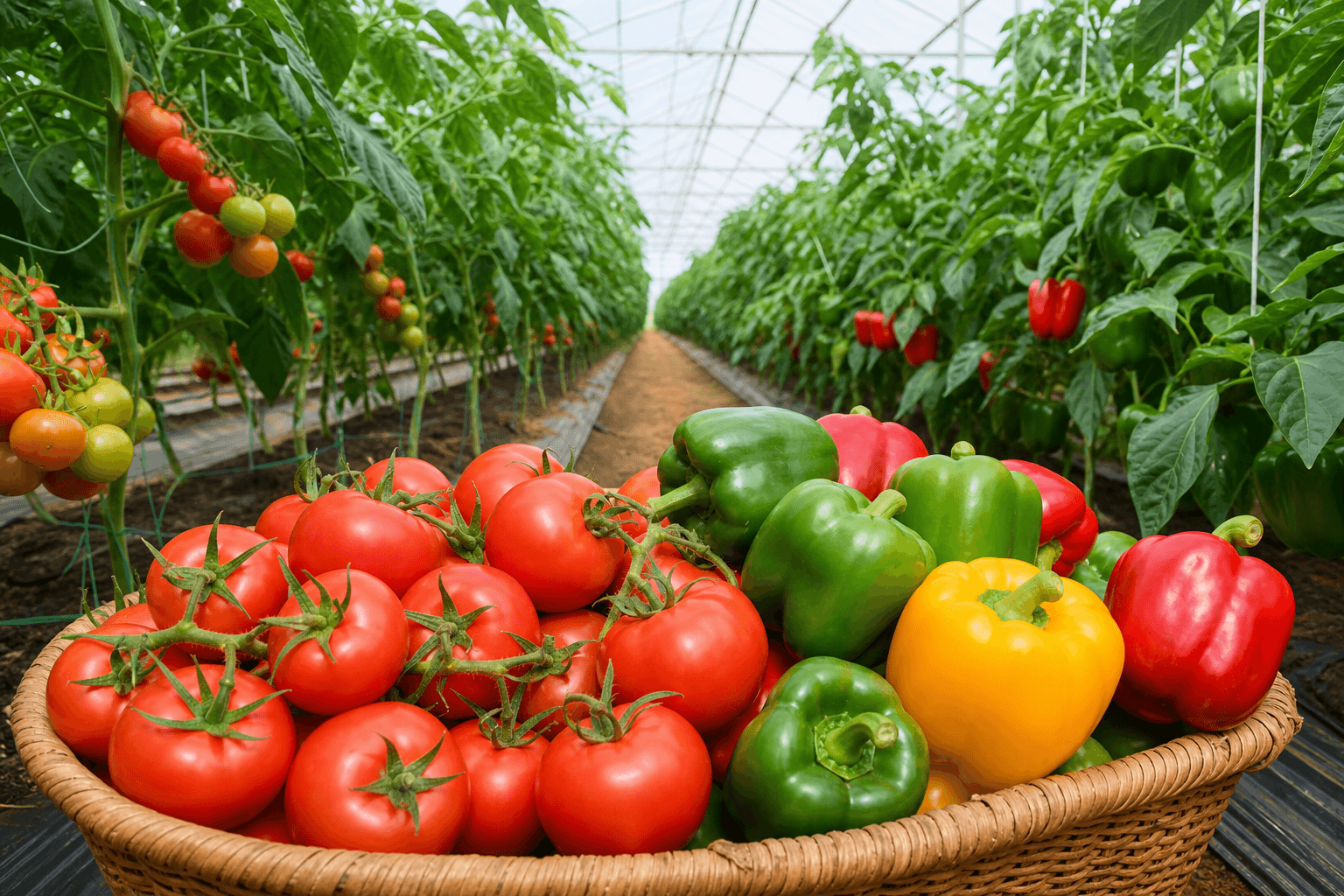
Do not grow low-value bulk crops — field spinach, okra, or cereal — in an expensive vertical system. The same mistake applies to polyhouses: growing cheap mandi crops in a ₹25–40 lakh per acre structure destroys ROI. Our high-profit polyhouse crops guide explains why coloured capsicum (~₹18.14 lakh net per acre per year) and seedless cucumber (~₹16.76 lakh) outperform bulk vegetables.
Revenue, ROI, and Market Growth
Commercial hydroponic operations growing lettuce, basil, cherry tomato, and bell pepper can generate ₹2–3 crore per year gross at 1-acre scale, with ROI of 20–30% per year and break-even in 3–4 years — but these are upper-bound hydroponic scenarios, not median vertical-farm results.
For vertical farming specifically, claimed payback periods run 18–30 months when selling into steady B2B channels. The Indian controlled-environment agriculture market is growing at roughly 18–21% CAGR, driven by urbanisation and food-safety awareness.
Treat every revenue projection as a sensitivity analysis. Ask: What if utilisation is 60% instead of 95%? What if electricity prices rise 15%? What if your anchor restaurant client switches suppliers?
Subsidy Routes — NHB and Protected Cultivation
There is no dedicated central scheme labelled "vertical farming subsidy." The practical route is the same as hydroponics: use NHB or state protected cultivation subsidy for the greenhouse or building shell, and finance the vertical racking and grow-light system through term debt or promoter equity.
Indicative support: 40–60% in some states via NHB/protected cultivation pathways. NHB offers a flat 50% credit-linked back-ended subsidy for commercial horticulture, with a ceiling of roughly ₹56 lakh per beneficiary (up to about ₹1 crore depending on structure and location). Minimum area: 4,000 sqm in general states, 1,000 sqm in NE and hilly areas.
Never start construction before receiving your Letter of Intent or Letter of Comfort from NHB or the state horticulture department. Building before approval permanently forfeits subsidy — the single most common disqualification in protected cultivation. Read our full polyhouse subsidy guide 2026 before applying.
Because government cost norms (₹844–1,650 per sqm depending on structure type) lag 2026 market rates, the effective subsidy is typically 35–40%, not the advertised 50%. Budget 15–20% extra cash beyond your loan margin for cost overruns.
Fan-and-pad hi-tech greenhouses carry cost norms of ₹1,400–1,650 per sqm; shade net houses are cheapest at ₹710 per sqm. A vertical farm inside a hi-tech shell inherits those norm calculations.
How Vertical Farming Compares to Other Modern Methods
| Method | Setup (indicative) | Subsidy route | Best for |
|---|---|---|---|
| Vertical farm (indoor) | ₹8 lakh – ₹1 crore+ | NHB shell only | Urban premium produce |
| Hydroponics (1 acre) | ₹70 lakh – ₹1.5 crore | NHB greenhouse shell | High-volume leafy greens |
| NV polyhouse (1 acre) | ₹25–40 lakh | NHB/MIDH 50% (effective ~35–40%) | Capsicum, cucumber, floriculture |
| Shade net house | Lowest per sqm (₹710 norm) | Up to 80% for small/marginal in some states | Nurseries, leafy veg in hot zones |
| PMKSY drip | Few lakh per acre | 45–55% central + state top-up | Open-field water saving |
For most first-time modern farmers, a 1,000 sqm starter polyhouse at ₹7–10 lakh (falling to ₹3.5–5 lakh after subsidy) offers lower risk than a fully indoor vertical stack. See the small and marginal farmer roadmap for a staged approach.
Application Process If You Use NHB Subsidy
If your vertical farm includes a subsidised greenhouse structure, follow the NHB process:
- Prepare a bankable DPR with DSCR ≥1.5, crop plan, and technical specs.
- Secure bank term-loan sanction.
- Apply at nhb.gov.in (processing fee roughly ₹5,000–10,000).
- Obtain Letter of Comfort (LoC) — NHB simplified the process in 2023, replacing the mandatory two-stage IPA + GoC with optional LoC plus mobile-app self-inspection.
- Build according to the approved DPR; deviation without written permission causes rejection.
- Pass Joint Inspection Team (JIT) verification or app-based self-inspection before back-ended subsidy is credited to your loan account.
Step-by-step details are in our polyhouse subsidy online apply guide and DPR writing guide.
Urban Players and Market Linkage
UrbanKisaan operates controlled-environment farms close to consumption centres, reducing transport loss and enabling same-day delivery. Ninjacart connects farmers to retailers and restaurants at scale. Both demonstrate that the bottleneck is often sales, not production.
Before you install grow lights, secure at least one of:
- A B2B contract with a retailer, hotel chain, or cloud kitchen
- A direct-to-consumer subscription model with proven demand in your pin code
- An aggregator relationship similar to organised farm-to-fork platforms
Skipping market linkage is mistake number six in our research list of subsidy and business failures — right after skipping training (a ₹5,000–10,000 short course often pays for itself) and buying uncertified seedlings instead of tissue-culture stock booked 3–4 months ahead.
Risks and Honest Limitations
Vertical farming in India faces real constraints:
- High energy cost without renewable offset
- Capital intensity comparable to or exceeding rural polyhouses
- No standalone subsidy for racks and lights — only the shell may qualify
- Talent gap — you need agronomy and basic automation skills
- Regulatory variation — food safety and building-use rules differ by municipality
Agrivoltaics and PM-KUSUM 2.0's announced 10 GW Agri-PV component target farming beneath solar panels on rural land — a different model from indoor vertical stacks. If you own rural acreage rather than urban floor space, read our agrivoltaics and PM-KUSUM 2.0 guide before committing to indoor vertical architecture.
Stacking Finance — AIF, NABARD, and PMKSY
Vertical farmers can layer finance tools from the complete subsidy schemes list:
- Agriculture Infrastructure Fund: 3% interest subvention on loans up to ₹2 crore for 7 years, stackable with NHB
- NABARD: Refinances bank loans; does not subsidise farmers directly but enables 7% crop loans (effective 4% on prompt repayment) and collateral-free agri loans up to ₹2 lakh
- PMKSY drip: If any part of your operation uses open-field or polyhouse beds with drip, apply separately on your state portal
Verify and Plan Before You Build
Vertical farming can work in India when crop choice, energy costs, and market contracts align. It is not a shortcut around the hard rules of government subsidy — apply before you build, use official portals (nhb.gov.in, state horticulture sites), and treat vendor income claims as scenarios to stress-test.
Start with honest maths on setup (₹8 lakh to ₹1 crore+), operating cost (₹5–10 lakh per acre per year plus up to 40% for energy), and payback (18–30 months in favourable cases). If the numbers only work with a 50% subsidy headline, recalculate at 35–40% effective subsidy — the reality most protected cultivation applicants actually receive.
Frequently asked questions
How much does a vertical farm cost in India?
Setup costs range from roughly ₹8 lakh for small indoor units to more than ₹1 crore for commercial-scale installations. NIAPER-cited figures put commercial vertical farming at ₹50 lakh to ₹1 crore per acre, plus ₹5–10 lakh per acre per year in operating costs. Verify current vendor quotes locally before budgeting.
Which crops work best in vertical farms in India?
Leafy greens, microgreens, herbs, and strawberries are the most common choices. These crops have short growth cycles, high per-unit value, and fit the limited headroom of stacked growing racks. They also align with urban demand from companies such as UrbanKisaan and Ninjacart.
Is there a government subsidy for vertical farming?
There is no dedicated vertical-farming scheme. Farmers can access 40–60% support in some states through NHB or protected cultivation routes — the same pathway used for greenhouse shells in hydroponics projects. Apply before construction and follow the Letter of Intent or Letter of Comfort rules described in our polyhouse subsidy guide.
What is the biggest operating cost in vertical farming?
Energy can account for up to 40% of total operating expenses, mainly for LED grow lights, climate control, and pumps. Factor electricity tariffs into your DPR and consider solar under PM-KUSUM where the site allows.
How fast can a vertical farm break even?
Industry and research estimates cited in programme materials suggest payback in 18–30 months for well-run units selling into organised retail or B2B supply chains. Income figures vary widely — treat upper-bound projections as scenarios, not guarantees.