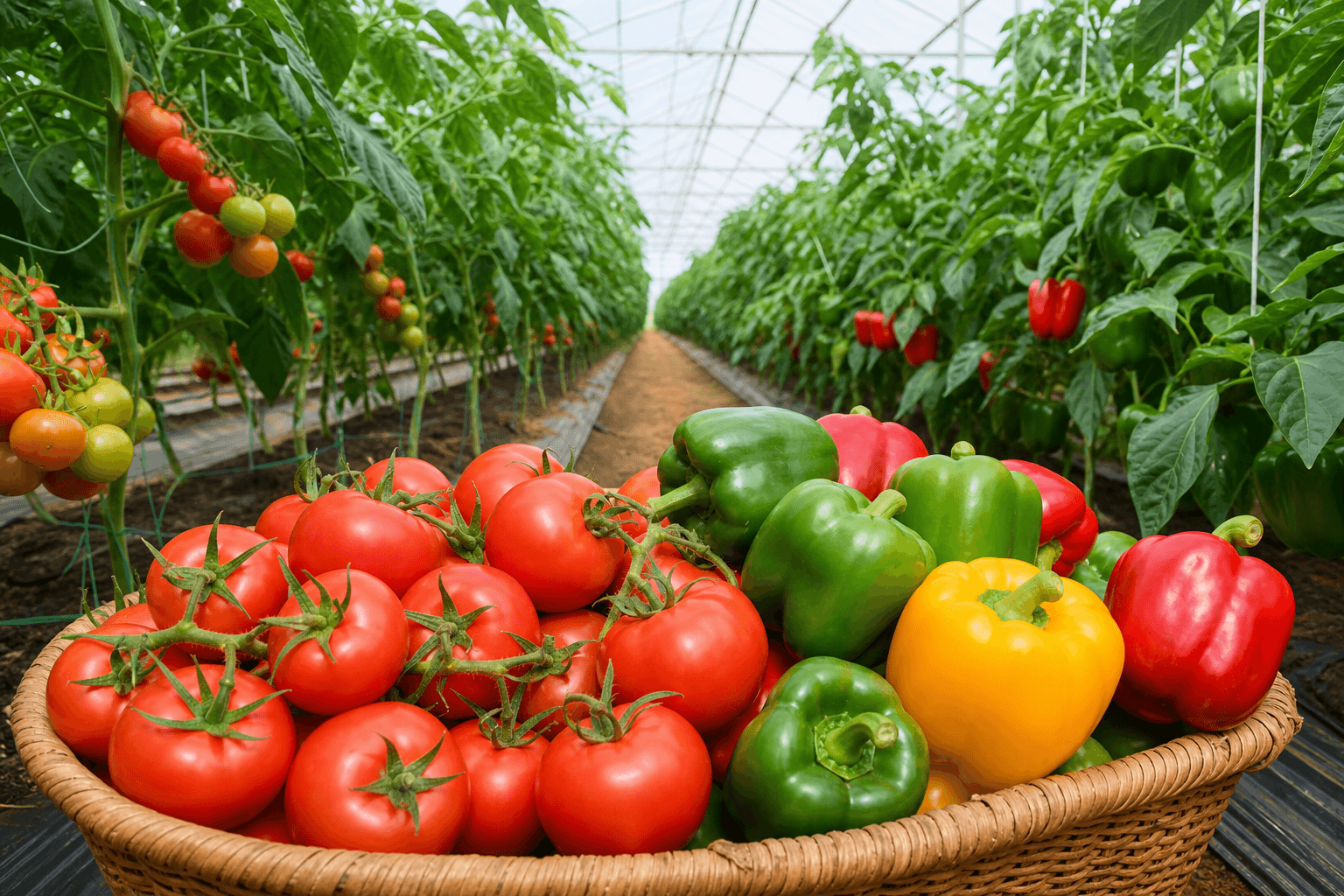
Polyhouse tomato 2026 — off-season rate sun kar bahut kisan transplant date fix kar dete hain, phir Tuta absoluta aur mandi crash ek saath aate hain. Yeh guide 2–3 crop calendar, yield per acre, price volatility, aur net profit bands deti hai — mandi rates illustrative only, live verify karo.
Related: cucumber polyhouse profit · best high-profit crops · heat wave cooling.
Is article ke saare mandi rate aur profit figure sirf planning ke liye illustrative hain. Wholesale prices har hafte badalti hain — city, variety, arrival volume par. Transplant se pehle e-NAM / Agmarknet / local commission agent se live rate lo. Bank DPR mein peak week ka rate guarantee mat likho.
Kyun polyhouse tomato — off-season premium
Naturally ventilated polyhouse (NVPH) tomato ko isliye choose karte hain:
- Off-season supply — jab open-field tomato kam ho, mandi premium possible (not guaranteed)
- Rain-free fruit — cracking kam, grade A % zyada
- 2–3 crop/year — cucumber se thoda long cycle, par rate spikes offset kar sakte hain
- Domestic retail — uniform red grade demand stable
Trade-offs: Tuta absoluta, leaf curl virus, summer heat NVPH mein 40°C+, aur mandi glut jab sab polyhouse ek saath harvest karein.
Structure cost subsidy se pehle ₹25–40 lakh/acre NVPH — polyhouse profit guide.
Crop calendar — 2 to 3 cycles
Indicative plains calendar (district climate adjust karo):
| Cycle | Transplant (indicative) | Duration | Notes |
|---|---|---|---|
| Crop 1 | Jul–Aug | ~120 days | Monsoon exit; humidity management |
| Crop 2 | Nov–Dec | ~115 days | Winter — often best IPM window |
| Crop 3 | Feb–Mar | ~125 days | Heat rising — cooling critical |
Fourth cycle risky — Tuta + virus pressure. 2 strong cycles > 3 weak cycles.
Cycle gap 15–20 days — structure sanitize, Tuta pupae soil mein na chhodne ke liye cleanup.
Yield per acre — tonnes per crop
Commercial NVPH tomato:
| Level | Per crop (tonnes/acre) | 2 crops/year | 3 crops/year |
|---|---|---|---|
| Beginner | 18–25 | 36–50 | 54–75 |
| Good management | 25–35 | 50–70 | 75–105 |
| Top commercial | 35–40+ | 70–80+ | 100+ (rare) |
Yield drivers:
- Hybrid variety — indeterminate staking varieties long harvest window
- Plant density — 8,000–12,000 plants/acre common trellis layouts
- Fertigation EC/pH — calcium at fruit set
- IPM — Tuta traps weekly check non-negotiable
- Pollination — bumblebee / manual shake where needed
Mandi rates — illustrative only (disclaimer)
Yeh live data nahi hai. DPR sensitivity ke liye teen scenario banao:
| Channel | Illustrative rate (₹/kg) | Planning note |
|---|---|---|
| Local mandi glut week | ₹8–15 | Oct–Nov peak supply crashes |
| Average wholesale | ₹18–30 | Grade B mix |
| Off-season / city wholesale | ₹35–55 | Uniform grade + transport |
| Rare peak (don't plan on this) | ₹80–120+ | 2–4 week windows only |
Contract farming / aggregator — fixed floor possible par penalty clauses padho.
Har harvest se pehle Agmarknet mandi name search karo.
Gross revenue — worked illustration
Assume 1 acre NVPH, 2.5 crops avg, 28 tonnes/crop = 70 tonnes/year
| Avg realisation | Gross turnover |
|---|---|
| ₹15/kg (bad year) | ₹10.5 lakh |
| ₹24/kg (mid) | ₹16.8 lakh |
| ₹38/kg (good off-season mix) | ₹26.6 lakh |
Running costs — subtract karo
Annual band (indicative):
| Item | Cost band |
|---|---|
| Seedlings / grafted plants | ₹2–3.5 lakh |
| Fertiliser + fertigation | ₹2.5–4 lakh |
| Crop protection (Tuta IPM heavy) | ₹2–4 lakh |
| Labour (harvest + staking) | ₹3–5 lakh |
| Power, packaging, transport | ₹1.5–2.5 lakh |
Total running: ₹8–14 lakh/year — tomato IPM cucumber se mehnga.
Net profit — before structure EMI
| Scenario | Illustrative net (after running cost) |
|---|---|
| Low price year | ₹0–3 lakh (loss possible) |
| Mid price year | ₹4–10 lakh |
| Strong off-season year | ₹10–18 lakh |
Structure loan EMI (post-subsidy) mid scenario net se fit hona chahiye — bank DSCR ≥ 1.5 chahta hai.
Horticulture literature best-case ₹15–20 lakh net/acre/year cite karti hai — treat as upper benchmark, first-year expectation nahi. Subsidy sirf capex kam karti hai; mandi year decide karti hai.
Tuta absoluta — risk management outline
Tuta polyhouse mein #1 profit killer:
- Pheromone traps — monitoring threshold before spray
- Biologicals — Trichogramma, Nucleopolyhedrovirus where recommended
- Selective chemistry — rotation to avoid resistance
- Sanitation — infected leaves/fruits bag and destroy
- Crop break — same structure mein continuous tomato mat rakho; cucumber/capsicum rotation
One missed week scouting = 40–60% yield loss possible.
Summer heat — NVPH tomato
May–June internal 42°C+ → flower drop, small fruit.
Mitigation (heat wave guide):
- Fogging / pad partial side
- Aluminet shade peak hours
- Ventilation max open
- Irrigation timing — mid-day stress avoid
Fan-pad greenhouse norm zyada — electricity ₹8k–25k/month summer possible.
Subsidy reminder
Apply before build — polyhouse subsidy guide 2026. DPR crop tomato ho to transplant wahi — bina permission capsicum switch = reject.
Integration with cooling & other crops
Summer cycle mein heat stress sabse bada yield killer hai — heat wave polyhouse cooling tips 2026 padho before March transplant. Crop rotation with cucumber between tomato cycles reduces Tuta carryover — see cucumber polyhouse profit for comparison economics.
Coloured capsicum needs longer cycle but steadier mandi in some belts — best high-profit crops compare before locking DPR.
Before you transplant
- Live mandi rate + 3-scenario DPR
- Tuta IPM budget line item — cheap nahi
- Buyer / aggregator kam se kam ek cycle ke liye
- Cooling plan summer cycle ke liye
- Labour harvest peak ke liye reserve
Disclaimer: Yield, price, profit district/weather/management par depend. Ask Kisan mandi agent nahi. Illustrative rates trading advice nahi.
Bottom line
Polyhouse tomato 2–3 crops/year, 50–100 tonne/acre potential, par Tuta + mandi volatility se net profit swing zyada hota hai cucumber se. Conservative DPR, strong IPM, aur peak rate par plan mat karo — tabhi structure EMI sustainable rehti hai.
Next: cucumber profit compare · crop list · cooling tips.
Frequently asked questions
How many tomato crops can I grow in a polyhouse per year?
In most Indian plains NVPH units, farmers plan 2–3 tomato crops per year depending on variety, transplant dates, and heat management. Each cycle typically runs 110–130 days from transplant to final harvest — rushing a fourth cycle often raises Tuta and virus pressure.
What is polyhouse tomato yield per acre?
Commercial projects target 25–40 tonnes per crop per acre under strong fertigation and pest scouting. With 2–3 crops per year, annual potential reaches roughly 50–100 tonnes per acre — upper range needs excellent IPM and cooling in summer cycles.
What mandi rate should I use for tomato profit planning?
Use illustrative wholesale bands only — ₹8–25/kg at local mandi in glut weeks, ₹20–45/kg in moderate seasons, and ₹50–120/kg for rare off-season peaks. Never base a bank DPR on peak mandi stories alone; verify live rates on e-NAM or Agmarknet.
What is Tuta absoluta and why does it matter in polyhouse tomato?
Tuta absoluta (tomato leaf miner) is a major polyhouse pest that causes leaf and fruit damage and rapid crop loss if unchecked. Pheromone traps, biopesticides, and selective chemistries in an IPM schedule are mandatory — one uncontrolled outbreak can cut a cycle by 40–60%.
What net profit is realistic from one acre polyhouse tomato?
After structure cost (often ₹25–40 lakh per acre before subsidy), running costs of ₹8–14 lakh per year, and volatile mandi prices, net profit in well-managed units ranges from breakeven to ₹10–18 lakh per year in literature — weak price years can lose money despite good yield.