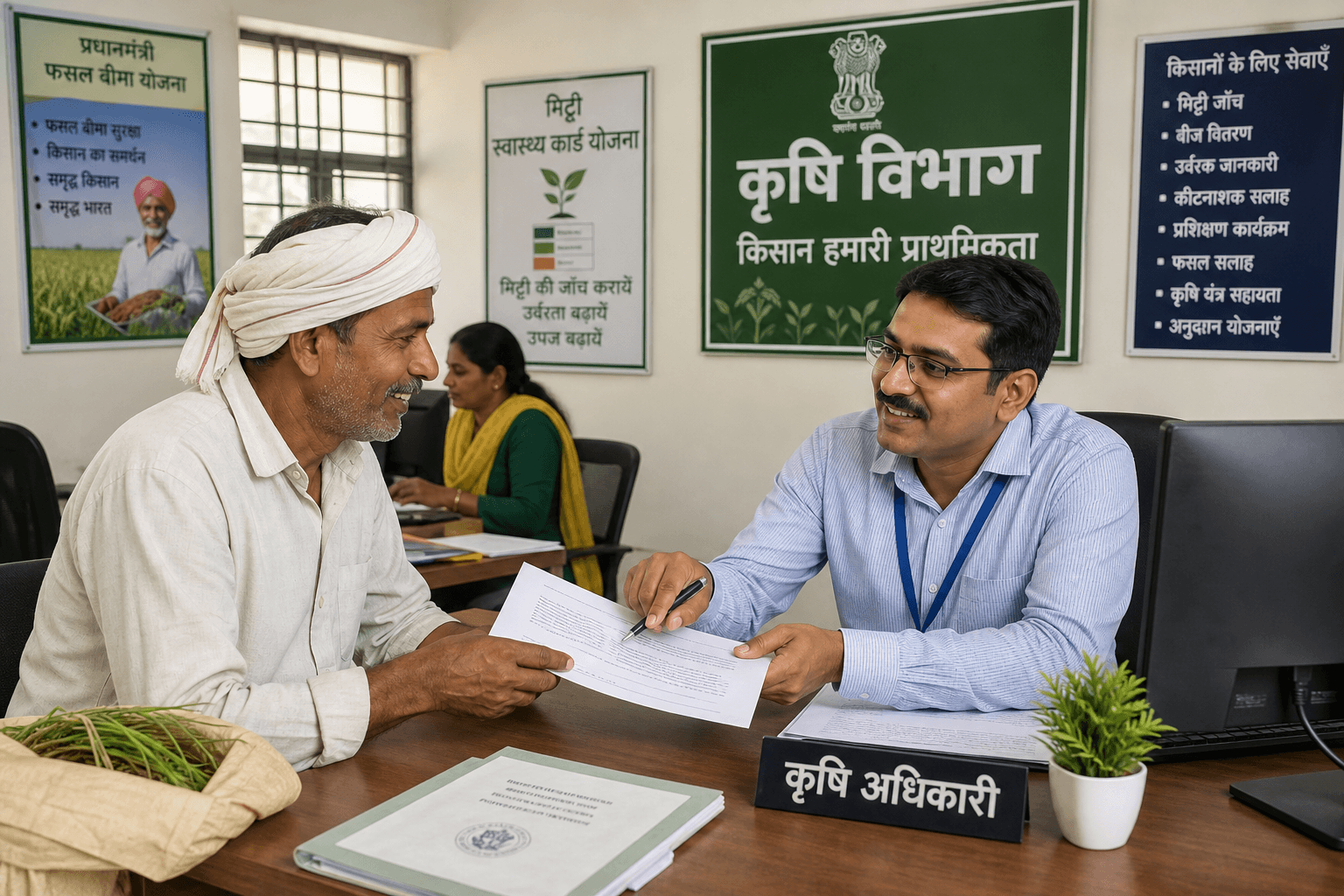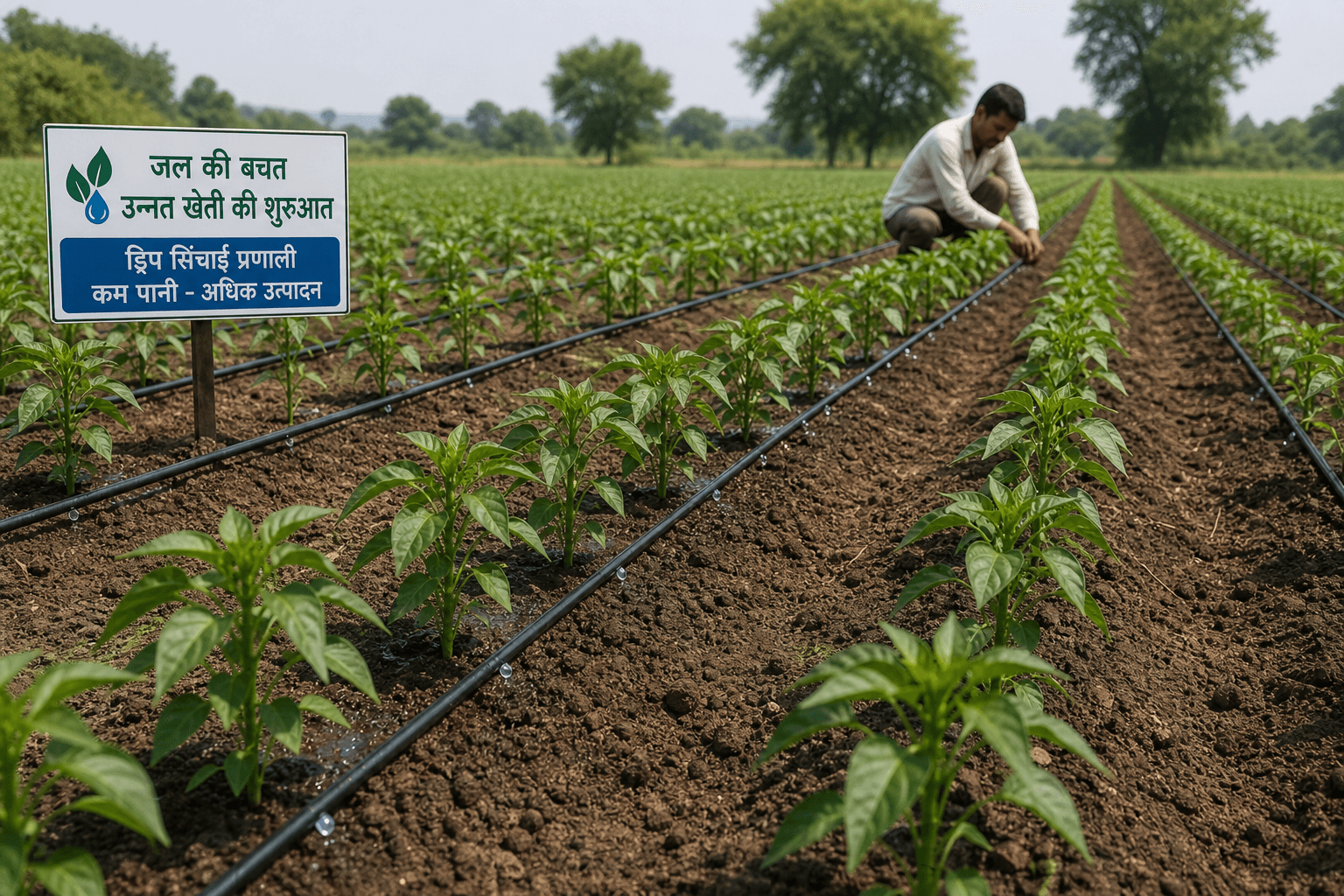
If you grow vegetables, orchards, or high-value crops on even a few acres, the single most practical upgrade you can make before investing in a polyhouse or solar plant is drip irrigation with fertigation. It costs far less than protected cultivation, the paperwork is simpler, and the returns show up in the first season through lower water bills, reduced fertiliser use, and better yields.
Under Pradhan Mantri Krishi Sinchayee Yojana (PMKSY), the Per Drop More Crop component offers central support for micro-irrigation — drip lines, sprinklers, and related infrastructure. This is one of the most widely used modern-farming subsidies in India, and it is often the first step in the roadmap we recommend for small and marginal farmers before they scale into polyhouse subsidy or PM-KUSUM solar income.
What PMKSY Per Drop More Crop Covers
PMKSY was designed to expand irrigated area, improve water-use efficiency, and promote precision application of inputs. The Per Drop More Crop sub-scheme specifically targets micro-irrigation systems: drip irrigation, sprinkler sets, and fertigation equipment that delivers fertiliser through the irrigation network.
Unlike capital-heavy projects such as naturally ventilated polyhouses (which run ₹25–40 lakh per acre before subsidy), a drip system is a comparatively affordable upgrade. That makes it ideal for farmers who want modern results without taking on a ₹30 lakh term loan on day one.
The programme sits alongside other central schemes — NHM/MIDH for horticulture structures, NHB for commercial protected cultivation, and PM-KUSUM for solar pumps. Understanding how they fit together is easier if you start with our complete government subsidy schemes list for 2026.
Subsidy Rates — Central Share and State Top-Ups
The central contribution under Per Drop More Crop is structured by farmer category:
- Small and marginal farmers: 55% central support
- Other farmers: 45% central support
States frequently add their own top-up, pushing the effective subsidy higher. Indicative examples from official programme summaries include:
| State / situation | Indicative top-up |
|---|---|
| Uttar Pradesh | Up to 90% for small farmers; 65–80% for others |
| Gujarat | Additional +10% in dark zones |
| Rajasthan | 60% on pipelines (combined with central share) |
| General range | States may top up to 60–90% total depending on category |
These percentages change with funding windows and state budgets. Always verify the current rate on your state portal — for example MPFSTS in Madhya Pradesh, i-Khedut in Gujarat, or uphorticulture.gov.in in Uttar Pradesh — before quoting numbers to your bank or vendor.
Subsidy percentages and application windows change annually. Treat every figure in this article as a starting point. Confirm the live rate, ceiling, and open dates on your state agriculture or horticulture department portal before placing orders with a dealer.
Why Drip Plus Fertigation Beats Flood Irrigation
The economic case for drip is strong even without subsidy, but the PMKSY support makes payback faster.
Water savings: Micro-irrigation can save roughly 70% of water compared with flood or furrow irrigation. In water-stressed districts — and in dark zones where Gujarat adds extra support — that alone can determine whether a crop survives a dry spell.
Fertiliser efficiency: Fertigation, which mixes soluble fertiliser into the drip stream, can cut fertiliser use by about 40% while maintaining or improving plant nutrition. Nutrients go directly to the root zone instead of being washed away.
Yield gains: Well-designed drip systems typically deliver a 20–30% yield improvement, especially for horticulture crops where moisture stress at flowering or fruit set causes immediate losses.
For farmers planning a polyhouse later, drip and fertigation are also part of the technical viability section in a bankable DPR. NHB expects specifications such as B-Class GI pipes, UV-stabilised components, and integrated fertigation in protected cultivation projects. Getting experience with drip on open field first reduces risk when you move into polyhouse farming.
Eligibility, Area Ceiling, and Re-Application
The scheme applies to individual farmers meeting state eligibility criteria — typically land ownership or a registered lease, Aadhaar linkage, and compliance with category definitions for small/marginal status where enhanced rates apply.
Key limits to remember:
- Maximum area per beneficiary: 5 hectares
- Re-application: The same land becomes eligible again after 7 years
The seven-year rule matters if you installed a basic drip set in 2019 and now want to upgrade to a fully automated fertigation system with filters, venturis, and solenoid valves. Check whether your state treats upgrades as a fresh application or an extension.
How to Apply — State Portals and DBT
Applications are submitted through state-level online portals, not a single national drip website. The process generally follows this pattern:
- Register on your state micro-irrigation portal with Aadhaar and mobile number.
- Upload land records — Jamabandi, 7/12 and 8-A, Khasra-Khatauni, or equivalent depending on your state.
- Link an Aadhaar-seeded bank account for Direct Benefit Transfer of the subsidy component.
- Select the system from an empaneled vendor list, if your state uses one.
- Submit during the open window and track approval status online.
In Madhya Pradesh, applications go through MPFSTS (mpfsts.mp.gov.in). Several states, including MP, use a lottery or computerized selection when demand exceeds the allocated budget. That means applying early in the window — MP farmers often target April to June for faster processing — improves your chances.
Documents You Should Keep Ready
While exact lists vary by state, keep these ready before you start the online form:
- Aadhaar card
- Land ownership or registered lease deed (registered, not merely notarised, if leasehold)
- Bank passbook linked to Aadhaar for DBT
- Caste certificate if applying under SC/ST enhanced categories
- Soil and water test reports — useful for fertigation planning and sometimes requested by the department
- Vendor quotation with GST, if the portal requires it at application stage
If you also plan protected cultivation, overlap document preparation with your polyhouse subsidy application — land records and bank details are the same.
State Examples — UP, Gujarat, and Rajasthan
Uttar Pradesh
UP offers among the highest combined rates: up to 90% for small farmers and 65–80% for others on top of the central baseline. Apply through uphorticulture.gov.in or the district horticulture office. Because rates are high, windows fill quickly — monitor announcements on the portal.
Gujarat
Gujarat runs applications through i-Khedut (ikhedut.gujarat.gov.in) on a first-come-first-served basis in many seasons. Farmers in dark zones receive an additional 10% top-up, reflecting the state's priority on water conservation in over-exploited blocks.
Rajasthan
Rajasthan provides 60% support on pipelines through RajKisan, with applications typically opening one to two times per year, often with lottery selection. Combine this with the state's polyhouse programmes if you are building a protected cultivation unit — see our state-wise polyhouse subsidy guide for portal links.
Fertigation — What to Install and Why
Fertigation is not a separate scheme, but it is the part of a drip system that turns water savings into profit. A basic fertigation setup includes:
- Venturi injector or fertiliser tank for drawing concentrated nutrient solution into the main line
- Disc or screen filters to prevent emitter clogging
- Pressure regulators for uniform flow across the field
- Soluble fertilisers matched to crop stage — nitrogen early, potassium during fruiting, micronutrients as needed
In a polyhouse growing coloured capsicum or seedless cucumber — crops that can net ₹16–18 lakh per acre per year under protected cultivation — fertigation precision directly affects fruit quality and market price. Even in open fields, fertigation through drip reduces labour for top-dressing and side-dressing.
Stacking PMKSY with Other Schemes
One of the most common questions we receive is whether drip subsidy conflicts with NHB, PM-KUSUM, or Agriculture Infrastructure Fund (AIF) loans.
In practice:
- PMKSY drip covers the micro-irrigation hardware on open or protected land.
- NHB/MIDH covers the polyhouse structure, often with drip/fertigation included in the DPR but subsidised under the horticulture component.
- PM-KUSUM Component B subsidises standalone solar pumps (up to 60% combined central and state share, with 50% central in NE/hilly areas), which pairs naturally with drip to eliminate diesel pumping costs.
- AIF offers 3% interest subvention on loans up to ₹2 crore for 7 years — stackable with NHB and PMKSY according to official guidance on agriinfra.dac.gov.in.
The small and marginal farmer modern farming roadmap lays out a sensible sequence: drip under PMKSY first, then a PM-KUSUM solar pump, then a 1,000 sqm starter polyhouse under NHB.
Common Mistakes to Avoid
- Buying equipment before approval — Some states require prior sanction. Confirm whether your state releases subsidy only after inspection, similar to the back-ended NHB model.
- Non-empaneled vendors — Quotations from unlisted dealers may be rejected.
- Undersized filters — Hard water or sediment clogs emitters within a season; invest in proper filtration upfront.
- Ignoring water quality — High electrical conductivity (EC) water damages drip lines and crops. Capsicum and gerbera in polyhouses often need RO treatment if EC is high — a point we cover in our common subsidy mistakes guide.
- Missing the application window — Lottery states like MP and Rajasthan do not accept late forms.
Cost Reality and Payback
Exact drip system costs depend on crop spacing, terrain, and automation level, and are not fixed in the central PMKSY circular. As a planning figure, a field-scale drip system on one acre typically costs a few lakh rupees before subsidy. After 45–55% central support plus state top-ups, farmer share can drop substantially — in UP, small farmers may pay only 10% of the project cost if the 90% combined rate applies.
Payback often comes within one to two seasons through water and fertiliser savings alone, before counting yield gains. That makes PMKSY one of the highest-return subsidies for ordinary farmers who are not yet ready for polyhouse-scale investment.
Verify Before You Invest
Every cost, subsidy percentage, and portal URL in this article should be confirmed on official government websites — nhb.gov.in, state horticulture portals, and your district agriculture office — before you sign a vendor contract or dig trenches. Scheme windows close, rates change, and lottery results are not appealable once the list is published.
Drip irrigation under PMKSY is the foundation layer of modern farming in India: lower risk, faster approval, and immediate impact on water and input costs. Build on it with solar pumping and protected cultivation when you are ready — and use the linked guides above to plan each step without losing subsidy eligibility.
Frequently asked questions
How much subsidy do small and marginal farmers get on drip irrigation under PMKSY?
Central support under the Per Drop More Crop component is 55% for small and marginal farmers and 45% for other farmers. Many states add top-ups that can raise the effective benefit to 60–90%, depending on category and location. Verify the current percentage on your state horticulture or agriculture portal before applying.
What is the maximum land area eligible for PMKSY drip subsidy?
The ceiling is 5 hectares per beneficiary under the scheme. The same land can become eligible again after 7 years, which matters if you are planning a second round of system upgrades or replacement.
Which documents are needed to apply for drip irrigation subsidy?
You typically need Aadhaar, land records, and an Aadhaar-seeded bank account for Direct Benefit Transfer. Application is done on your state portal — for example MPFSTS in Madhya Pradesh. Some states select beneficiaries through a lottery, so timely submission during the open window is important.
How much water and fertiliser does drip irrigation save?
Research cited in government programme materials indicates roughly 70% water savings, about 40% fertiliser savings, and a 20–30% yield improvement compared with flood irrigation when the system is designed and managed properly.
Can drip irrigation subsidy be combined with polyhouse or solar schemes?
Yes. PMKSY drip support can stack with other programmes such as NHB protected cultivation subsidy and PM-KUSUM solar pumps. See our complete scheme list and the small-farmer roadmap for how to layer benefits without breaking eligibility rules.