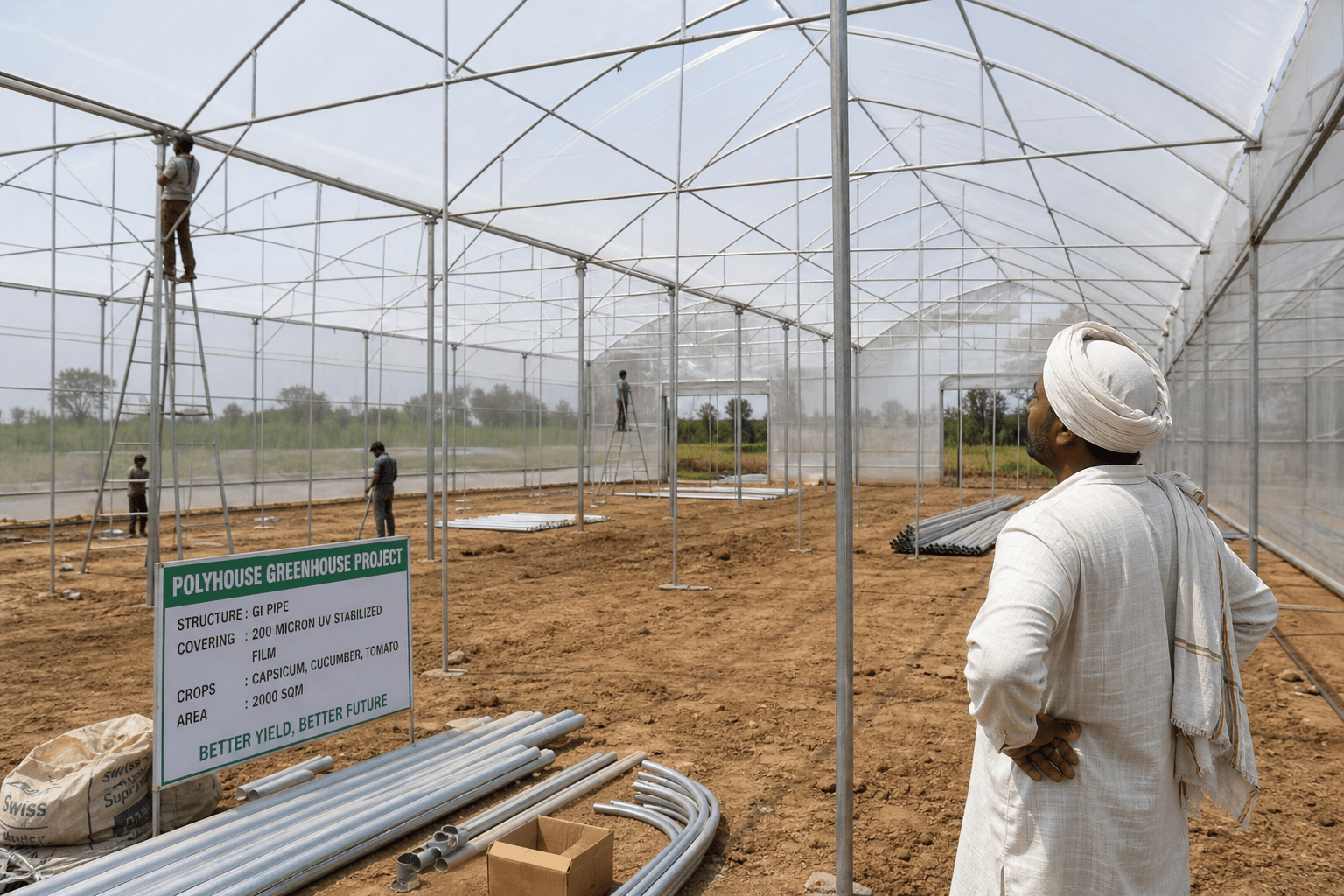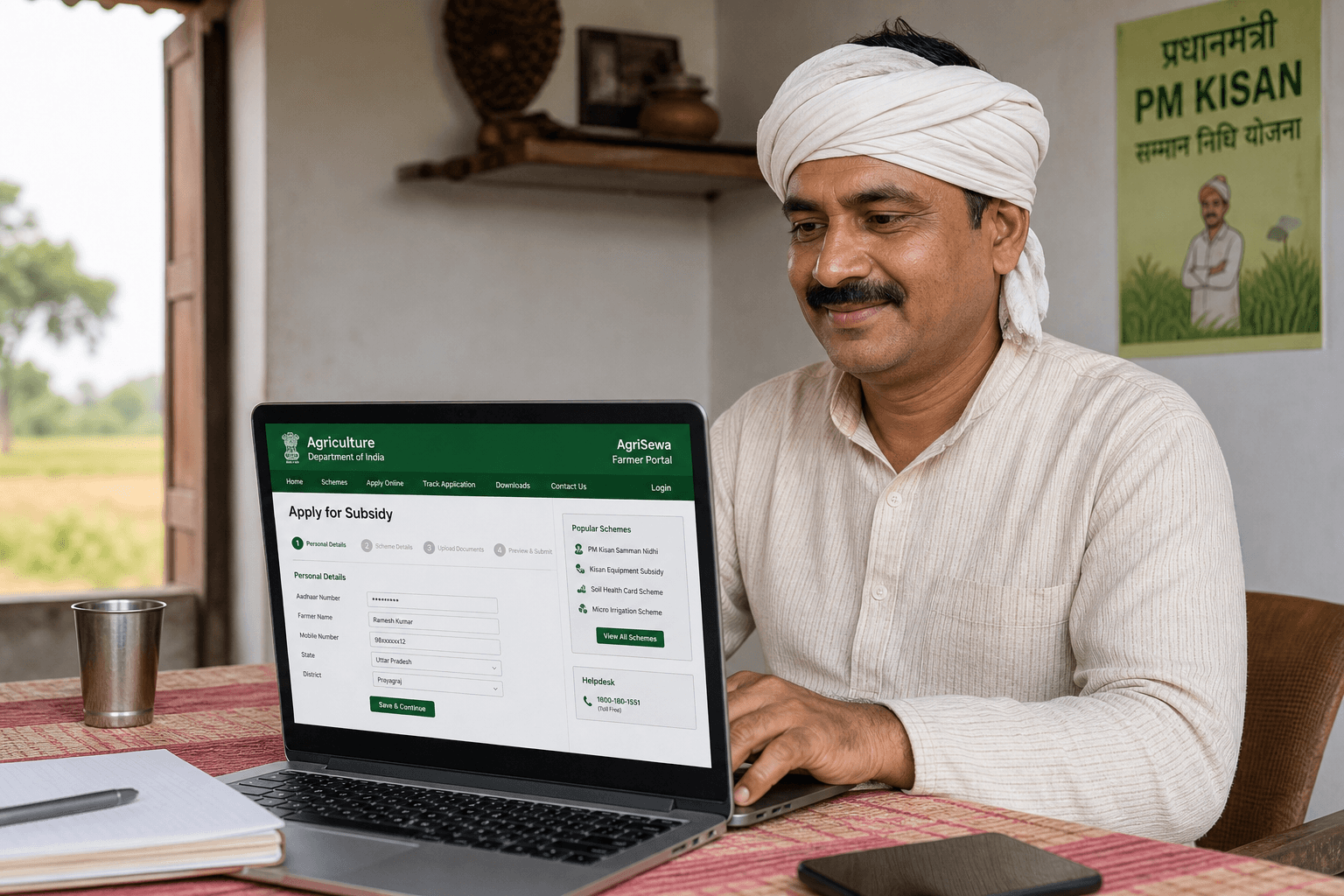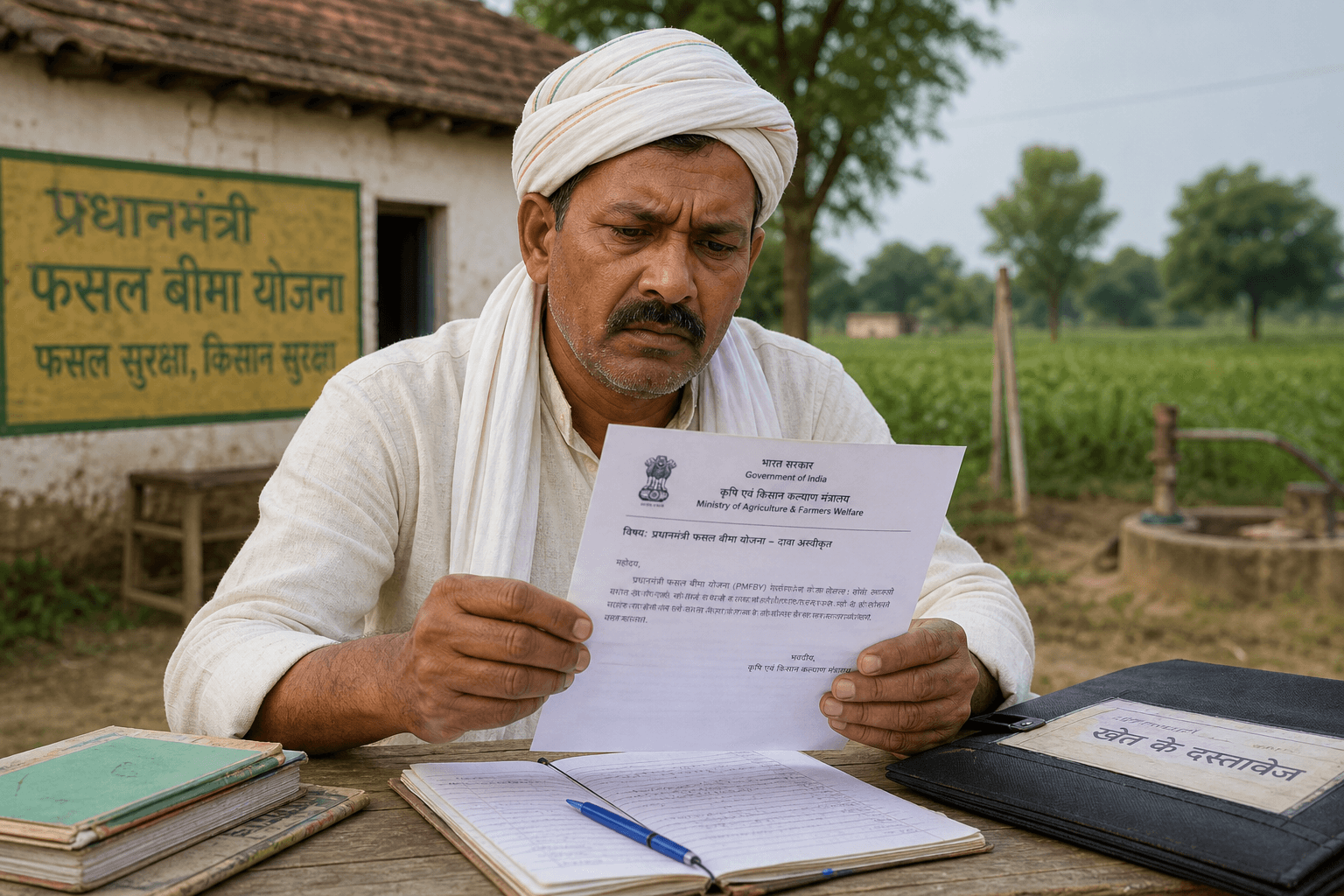
Every year, thousands of Indian farmers lose polyhouse, drip, and drone subsidies — not because schemes ran out of money, but because of preventable mistakes. District horticulture offices and NHB process thousands of rejections where the farmer did everything except follow the sequence: DPR → bank sanction → LOI/LoC → then build.
This article documents the nine most common failure reasons from official scheme compliance data and field reports. Each mistake below has caused real subsidy cancellations. Avoid them, and you protect lakhs of rupees in back-ended support. Repeat them, and no bank manager or consultant can restore your forfeited claim.
For the complete subsidy workflow, start with our Polyhouse Subsidy Guide 2026. For step-by-step application, see Polyhouse Subsidy Online Apply — Step by Step.
Mistake 1 — Starting Construction Before LOI or LoC
Severity: Permanent disqualification. No appeal.
This is the number-one subsidy killer in Indian protected cultivation. Under NHB and MIDH, you must:
- Prepare a bankable DPR with DSCR ≥ 1.5.
- Obtain bank term-loan sanction.
- Apply on nhb.gov.in and receive Letter of Intent (LOI) or Letter of Comfort (LoC).
- Only then begin construction.
Farmers who pay vendors a mobilisation advance before step 3 — often pressured by agents saying "scheme window is closing" — forfeit subsidy permanently. The Joint Inspection Team (JIT) checks construction start dates against LOI/LoC issuance dates. NHB's 2023 simplified process (optional LoC plus mobile-app self-inspection, PIB PRID 1906941) does not relax this rule.
Never break ground, pour foundations, or erect GI poles before LOI/LoC and bank term-loan sanction. This single mistake cannot be fixed retroactively — not by political recommendation, not by re-applying, not by NABARD refinancing.
What to do instead: Pay vendors only for DPR design and quotation. Lock a construction slot conditional on LOI receipt. Document the empty site with dated geo-tagged photos before construction starts.
Mistake 2 — Believing the "50% Subsidy" Headline
Severity: Financial shortfall mid-project; incomplete construction fails inspection.
Scheme brochures advertise 50% subsidy under NHM/MIDH/NHB. The calculation uses government cost norms, not your vendor's invoice:
| Structure / Slab | Cost Norm (₹/sqm) |
|---|---|
| NVPH up to 500 sqm | 1,060 |
| 500–1,008 sqm | 935 |
| 1,008–2,080 sqm | 890 |
| 2,080–4,000 sqm | 844 |
| Fan-and-pad hi-tech | 1,400–1,650 |
| Shade net | 710 |
Market construction rates for a naturally ventilated polyhouse run ₹25–40 lakh per acre while norms on 4,000 sqm may total ₹33.76 lakh at ₹844 per sqm. At 50% on the norm, you receive approximately ₹16.88 lakh — but your actual bill might be ₹35 lakh. Effective subsidy: 35–40%, not 50%.
State top-ups (Maharashtra 65–70%, Telangana 95% for SC/ST, MP 80% for small/marginal/SC/ST) improve the ratio — but only if you verify current percentages on your state portal.
What to do instead: Keep 15–20% extra cash beyond your planned promoter margin. Build the DPR funding table on cost norms, not vendor quotes. Read the effective-subsidy reality check in our Polyhouse Subsidy Guide 2026.
Mistake 3 — Growing Low-Value Crops in Expensive Infrastructure
Severity: Project fails financially; bank NPA risk; inspection notes non-viability.
A polyhouse costing ₹25–40 lakh per acre before subsidy must grow crops that justify the investment:
| Crop | Net Return (per acre/year) |
|---|---|
| Coloured capsicum | ~₹18.14 lakh (Agrifirst NVPH data) |
| Seedless cucumber | ~₹16.76 lakh |
| Dutch rose | ₹12–18 lakh (highest risk) |
| Gerbera | ₹10–15 lakh |
| Spinach, okra | Far below infrastructure cost |
Farmers who plant spinach or okra because seeds are cheap end up with mandi prices that cannot service their term loan. The subsidy may technically credit, but the project collapses — and banks black-list the location for future agri credit.
What to do instead: Match crop to infrastructure. Capsicum offers the best profit-versus-risk balance for first-timers. Cucumber gives fastest cash flow (harvest from ~35 days, 2–3 cycles per year). Pre-arrange market linkage with mandi aggregators or exporters before planting.
Mistake 4 — Buying Roadside Nursery Plants Instead of Certified Seedlings
Severity: Crop failure, delayed production, DPR yield mismatch at audit.
Protected cultivation requires certified tissue-culture or pro-tray seedlings — booked 3–4 months ahead for capsicum, cucumber, and floriculture. Roadside nursery plants carry disease, inconsistent genetics, and unpredictable yields. When your DPR projects 32–50 tonnes per acre of capsicum and you deliver 8 tonnes, the bank questions your financial viability.
What to do instead: Contract reputable nurseries at DPR stage. Include seedling supplier quotation in NHB annexures. Attend KVK training (₹5,000–10,000 short courses pay for themselves) on seedling handling and transplanting.
Mistake 5 — Skipping Training
Severity: Operational errors reduce yield; higher rejection risk in scheme audits.
Scheme compliance is not just paperwork — it is production competence. Farmers who skip horticulture training frequently mismanage fertigation, IPM schedules, and harvest timing. Capsicum prices peak October–December at ₹75–150 per kg when supply is tight; missing that window because you did not understand crop cycle planning destroys revenue.
What to do instead: Complete a state horticulture department or KVK short course before construction. Attach training certificate to your DPR. For mushroom projects, train at ICAR-Directorate of Mushroom Research (Solan). For drones, use KVK demonstration programmes before buying through SMAM.
Mistake 6 — Not Pre-Arranging Market Linkage Before Planting
Severity: Harvest sold at distress prices; loan default; project abandonment.
A polyhouse full of coloured capsicum with no buyer is a warehouse, not a business. Not pre-arranging market linkage is a documented failure reason across protected cultivation schemes. Exporters and modern retail want consistency — they commit to farmers who commit to them.
What to do instead: Secure letters of intent from buyers before planting. For organic routes, plan PKVY certification (₹31,500 per hectare over 3 years) and APEDA export pathway. For floriculture, Dutch rose needs guaranteed market before planting due to highest cost and risk profile.
Mistake 7 — Deviating from the Approved DPR Without Written Permission
Severity: Automatic rejection at JIT inspection.
Your DPR specifies structure type, dimensions, crop, and irrigation system. Common deviations that trigger rejection:
- Switching from capsicum to roses after approval
- Adding fan-and-pad cooling not in the approved design
- Reducing area below minimum (4,000 sqm general / 1,000 sqm NE-hilly)
- Changing from NVPH to shade net without amendment
The JIT compares physical reality to the approved DPR line by line. Any deviation without written NHB or state nodal officer permission causes rejection.
What to do instead: Submit a formal DPR amendment before making changes. Wait for written approval. Update bank loan sanction if cost changes. See How to Write a DPR for Polyhouse Subsidy for compliant structure.
Mistake 8 — Buying Non-DGCA or DJI Drones for SMAM Subsidy
Severity: Subsidy quotation rejected; illegal equipment seizure risk.
Under SMAM and Namo Drone Didi, only DGCA-approved Indian drones qualify. DJI and imported drones are not allowed. Farmers who purchase grey-market drones and then apply for 50% subsidy (up to ₹5 lakh for individual small/marginal/women/SC/ST farmers) or 80% subsidy (up to ₹8 lakh for women SHGs under Namo Drone Didi) face automatic quotation rejection on agrimachinery.nic.in.
What to do instead: Verify DGCA type certificate on every vendor quotation. Apply on the portal before purchase. For drone economics and stacking with PMKSY drip, see our Drone Farming & SMAM Subsidy Guide.
The DJI ban applies specifically to subsidised procurement and commercial agricultural spraying compliance — not to every personal drone use. But for SMAM/Namo Drone Didi money, Indian DGCA-approved models are the only path.
Mistake 9 — Misjudging Water Quality (High EC Without RO)
Severity: Crop failure; inspection notes non-viable project; financial distress.
Capsicum and gerbera are salt-sensitive. If your borewell water EC is high and you plant without an RO plant, seedlings burn, yields collapse, and the project cannot service its loan. Water EC misjudgement is a documented failure reason — especially in semi-arid districts where farmers assume "water is water."
What to do instead: Test water EC, pH, and TDS before writing your DPR. Include RO plant in project cost and annexures if EC exceeds crop tolerance. Cherry tomato is more salt-tolerant than capsicum — a DPR crop switch worth considering in brackish-water zones (with written approval if changing post-sanction).
Bonus Mistakes — Lease Deeds, Photos, and Scheme Stacking Errors
Beyond the core nine, field officers report these additional rejection triggers:
Notarised lease instead of registered deed
NHB requires registered lease deed valid 10–15+ years or ownership land records (Jamabandi, 7-12 and 8-A, Khasra-Khatauni). Notarised rent agreements fail document screening.
Missing geo-tagged construction photos
The 2023 NHB app-based self-inspection process requires geo-tagged construction-stage photos. Farmers who build without documentation cannot prove compliance timeline.
Applying for subsidy without bank term-loan sanction
NHB subsidy is credit-linked. No sanction letter = no application pathway. NABARD refinances the bank loan at backend — farmers do not apply to NABARD directly. See NABARD Loan for Farmers.
Ignoring AIF registration
Farmers who skip Agriculture Infrastructure Fund registration (3% interest subvention for 7 years on loans up to ₹2 crore) pay more interest than necessary. Not a rejection reason, but a costly oversight stackable with NHB and PMKSY.
The Correct Sequence — What Success Looks Like
| Step | Action | Mistake Avoided |
|---|---|---|
| 1 | Water and soil testing | #9 High EC |
| 2 | DPR with DSCR ≥ 1.5 | Bank rejection |
| 3 | Market linkage letters | #6 No buyer |
| 4 | Training certificate | #5 Skipping training |
| 5 | Bank term-loan sanction | Credit-link failure |
| 6 | NHB application → LOI/LoC | #1 Early construction |
| 7 | Certified seedlings ordered | #4 Roadside plants |
| 8 | Construction per DPR | #7 Deviation |
| 9 | Geo-tagged milestone photos | Documentation gap |
| 10 | JIT inspection → subsidy to loan | Full compliance |
How Rejection Impacts Your Next Application
A rejected NHB claim often flags your survey number in district records. Re-applying requires a fresh DPR, new bank assessment, and sometimes a new funding window wait (Rajasthan: 1–2 applications per year via lottery; Maharashtra: MahaDBT lottery). Permanent forfeiture from early construction means you absorb 100% of build cost with zero back-ended support — turning a ₹35 lakh project into a full-price gamble.
For small and marginal farmers planning their first modern investment, the Small & Marginal Farmer Modern Farming Roadmap sequences lower-risk steps (PMKSY drip, shade net, 1,000 sqm starter polyhouse) before major capital deployment.
The Bottom Line
Subsidy cancellation is almost never bad luck. It is a compliance failure — building too early, budgeting on the 50% headline, planting wrong crops, buying wrong drones, or ignoring water quality. Follow the sequence, keep 15–20% extra cash, grow high-value crops with market linkage, and treat your DPR as a binding contract with the inspection team. The farmers who get subsidised are not luckier; they are more disciplined.
Disclaimer: Scheme rules, rejection criteria, and cost norms change by state and funding window. Verify on nhb.gov.in, agrimachinery.nic.in, and your state horticulture portal before investing.
Last verified: May 2026
Frequently asked questions
What is the most common reason polyhouse subsidy is cancelled?
Starting construction before receiving the Letter of Intent (LOI) or Letter of Comfort (LoC) and bank term-loan sanction. This causes instant, irreversible disqualification — the subsidy is permanently forfeited with no appeal path.
Why is my 50% polyhouse subsidy actually less than half my bill?
Government cost norms (₹844–1,650 per sqm) lag 2026 market construction rates. Subsidy is calculated on the norm, not your vendor invoice. The effective subsidy is typically 35–40%, not 50%.
Can I change my polyhouse crop after subsidy approval?
No, not without written permission from NHB or your state nodal officer. Deviating from the approved DPR crop or structure without written permission causes automatic rejection at Joint Inspection Team verification.
Are DJI drones eligible for SMAM subsidy?
No. Only DGCA-approved Indian drones qualify. Imported drones including DJI models are illegal for subsidised purchase and quotations are rejected on agrimachinery.nic.in.
What water quality problem kills polyhouse projects?
High EC (electrical conductivity) water without RO treatment. Capsicum and gerbera are salt-sensitive. Misjudging water quality leads to crop failure and undermines the viability case during inspection.