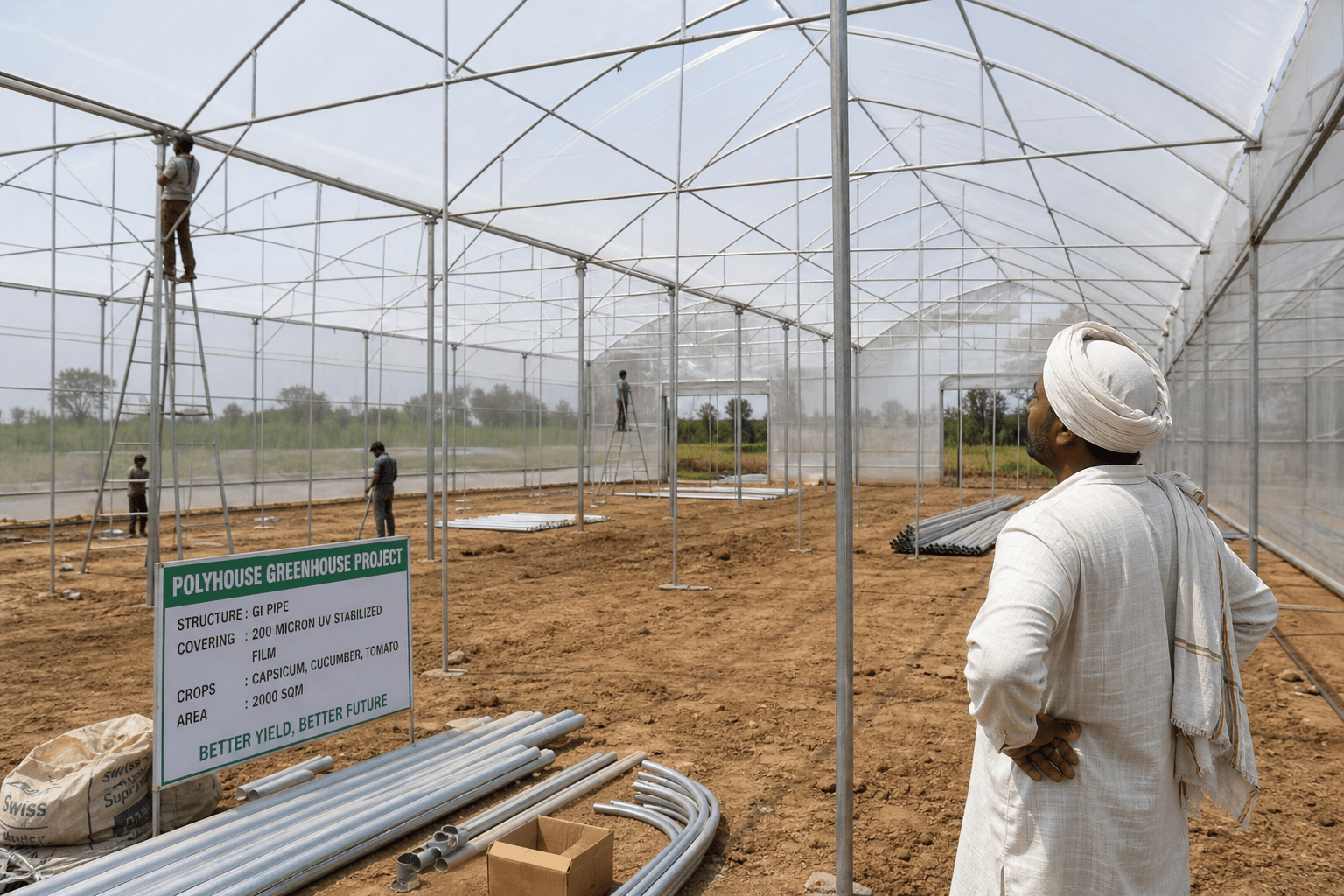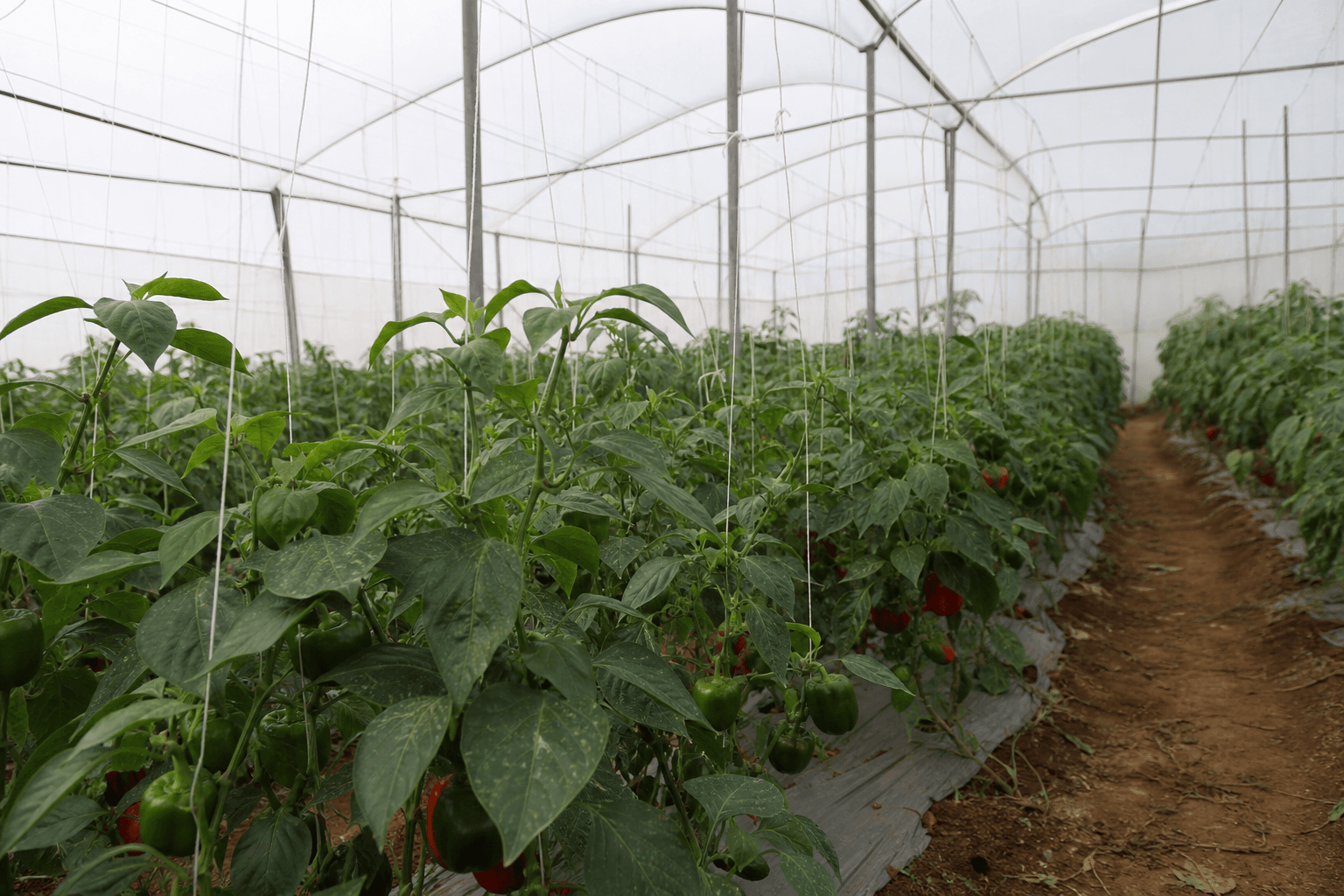
Polyhouse subsidy in India is never just "50% everywhere." The central government sets a 50% baseline under NHM, MIDH, and NHB—but states add top-ups that can push effective support to 65–95% for general, SC/ST, small, marginal, and hilly-area farmers. Application methods differ too: Maharashtra runs a lottery on MahaDBT, Telangana offers 75% general and 95% SC/ST through its horticulture portal, and Haryana processes first-come-first-served applications on HORTNET.
This state-wise guide gives you the full comparison table, explains the central rules that apply in every state, and links to our master polyhouse subsidy guide 2026 for the LoI/LoC rule and effective 35–40% subsidy reality check.
Verify every percentage on your state's official .gov.in portal before construction. Subsidy windows, funding caps, and top-ups change annually. Building before receiving a Letter of Intent or Letter of Comfort permanently forfeits subsidy nationwide—not only in one state.
Central rules that apply in every state
Before comparing states, understand what is constant:
Subsidy baseline and ceilings
- NHM / MIDH: 50% protected cultivation; max area 4,000 sqm per beneficiary via state horticulture departments
- NHB: flat 50%, credit-linked back-ended, ceiling ~₹56 lakh per beneficiary (up to ~₹1 crore depending on structure/location)
- Minimum area: 4,000 sqm general / 1,000 sqm NE-hilly
- NE/Himalayan states: 90% central share under HMNEH
Cost norms (subsidy is calculated on these, not market quotes)
| Structure | Cost norm (₹/sqm) |
|---|---|
| Shade net house | 710 |
| NV polyhouse — up to 500 sqm slab | 1,060 |
| NV polyhouse — 500–1,008 sqm | 935 |
| NV polyhouse — 1,008–2,080 sqm | 890 |
| NV polyhouse — 2,080–4,000 sqm | 844 |
| Fan & pad hi-tech greenhouse | 1,400–1,650 |
| Hilly areas | +15% on norms (NHB Appendix-1-B) |
Because 2026 market construction costs exceed norms, your effective subsidy is typically 35–40% of actual spend—not the advertised 50%. Budget 15–20% extra cash beyond bank margin. Our polyhouse subsidy pillar guide explains this in detail.
The apply-before-build rule
Secure bank term-loan sanction and apply before construction. NHB's 2023 reform introduced optional Letter of Comfort (LoC) plus mobile-app self-inspection; legacy Letter of Intent (LoI) + Joint Inspection Team (JIT) flows still circulate. Deviating from approved DPR crop or structure without written permission causes automatic rejection.
Full state-wise polyhouse subsidy comparison table
Central baseline is 50% everywhere, with 90% central share in NE/Himalayan states under HMNEH. State summaries below are indicative—verify exact current percentages on each portal.
| State | Subsidy % | Portal | Method |
|---|---|---|---|
| Maharashtra | 50% + top-up to 65–70% | MahaDBT (mahadbt.maharashtra.gov.in) | Computerized lottery; needs 7/12 & 8A |
| Haryana | SC owner 85%, SC lease 65%, general 50% | HORTNET / hortharyana.gov.in | First-come-first-served; self-install option |
| Telangana | 75% general, 95% SC/ST (up to 3 acres) | horticulture.tg.nic.in | Highest in India |
| Andhra Pradesh | 50% standard (≤4,000 sqm); SC/ST up to 95% | via District Horticulture Officer | DPR + DHO |
| Rajasthan | 50% general, 70–95% SC/ST & small/marginal | RajKisan | Applications 1–2×/year; lottery |
| Madhya Pradesh | 50% on cost norm; 80% small/marginal/SC-ST | MPFSTS (mpfsts.mp.gov.in) | Online; apply Apr–Jun for speed |
| Uttar Pradesh | 50% general (higher SC/ST) | uphorticulture.gov.in | Online + DHO verification |
| Gujarat | 50–90% (SC/ST higher) | i-Khedut (ikhedut.gujarat.gov.in) | First-come-first-served |
| Karnataka | MIDH 50% | horticulturedir.karnataka.gov.in | Offline; land ≥2× polyhouse area |
| Tamil Nadu | MIDH-NHM via TANHODA | tnhorticulture.tn.gov.in | Back-ended; via DHO/online |
| Bihar | 50% at ₹935/sqm (FLD 75% for 2,000 sqm) | DBT Agriculture + horticulture.bihar.gov.in | 13-digit DBT registration |
| Himachal Pradesh | Up to 85% general (hilly); MMGRS renovation 50% | eudyan.hp.gov.in | DHO; affidavit (no sublease) |
| Uttarakhand | 70% (CM scheme, ₹304 cr, 17,648 units of 100 sqm) | Block / DHO office | Offline form |
| Kerala | Up to 75% protected cultivation (greenhouse ≤500 sqm) | SHM Kerala (shm.kerala.gov.in) | State Horticulture Mission |
| Punjab | NHM 50% general | via DHO / state horticulture | — |
| Assam & NE states | 90% central share (HMNEH) | dirhorti.assam.gov.in | Covers Meghalaya, Nagaland, Tripura, etc. |
| Odisha | NHM/SHM | APICOL (agri.odisha.gov.in) | DPR via APICOL/OUAT/CA + nodal officer |
| West Bengal / Chhattisgarh / Jharkhand | NHM/SHM via DHOs | state agri/horticulture depts | Exact % and portals need official verification |
State highlights — where policies differ most
Telangana — highest top-ups
75% for general farmers and 95% for SC/ST (up to 3 acres) make Telangana the most aggressive state in the table. Apply through horticulture.tg.nic.in. Even here, cost-norm mechanics cap effective support versus vendor quotes—do not skip the 35–40% reality check.
Maharashtra — lottery discipline
MahaDBT runs a computerized lottery. You need 7/12 and 8A land records. Top-ups reach 65–70% above the 50% baseline. Lottery states punish incomplete applications—double-check documents before the window closes.
Haryana — ownership vs lease matters
SC owners: 85%, SC leaseholders: 65%, general: 50%. HORTNET offers first-come-first-served processing and a self-install option for farmers who can manage vendor coordination.
Madhya Pradesh — small farmer advantage
80% for small, marginal, and SC/ST farmers on the cost norm makes MP attractive for entry-level protected cultivation. Apply online at MPFSTS; April–June applications reportedly process faster.
Gujarat — wide SC/ST band
i-Khedut portal handles 50–90% depending on category, first-come-first-served. Monitor portal openings—popular windows fill quickly.
Northeast and Himachal — hilly premiums
Assam and other NE states: 90% central share (HMNEH) via dirhorti.assam.gov.in, covering Meghalaya, Nagaland, Tripura, and others. Minimum NHB area: 1,000 sqm for NE-hilly vs 4,000 sqm general.
Himachal Pradesh: up to 85% general (hilly) on eudyan.hp.gov.in; MMGRS renovation 50%.
Uttarakhand CM scheme: 70%, ₹304 crore, 17,648 units of 100 sqm—block/DHO offline forms.
States needing extra verification
West Bengal, Chhattisgarh, Jharkhand, and Punjab use NHM/SHM via DHOs, but exact percentages and named portals could not be confirmed from primary government sources in the research compendium. Label these as indicative—verify locally before DPR investment.
NHB route vs state horticulture route — which to choose?
| Factor | NHB (nhb.gov.in) | State NHM/MIDH |
|---|---|---|
| Subsidy rate | Flat 50% | 50% + state top-ups |
| Max beneficiary ceiling | ~₹56 lakh–₹1 crore | Varies by state fund |
| Processing fee | ~₹5,000–10,000 | Often nil or minimal |
| 2023 reform | LoC + app self-inspection option | State-specific |
| Best for | Commercial scale, credit discipline | Maximum state top-up (e.g., Telangana 95%) |
Many farmers apply through state portals when top-ups exceed NHB's flat 50%, provided double-subsidy rules are not violated. Discuss with your DHO and lending bank.
Application documents — common checklist
Regardless of state portal:
- Aadhaar, PAN, SC/ST caste certificate (if applicable)
- Land records: Jamabandi, 7/12 & 8-A, Khasra-Khatauni, or registered lease deed valid 10–15+ years
- 3–4 vendor quotations with GST
- Soil and water test reports (high EC needs RO before capsicum/gerbera)
- Bank term-loan sanction letter
- Aadhaar-linked passbook
- Bankable DPR with DSCR ≥1.5, crop plan, yield/price projections
- Geo-tagged construction-stage photos
Joint Inspection Team (or app self-inspection) verifies built structure against DPR before back-ended subsidy credits the loan account.
Stacking with Agriculture Infrastructure Fund
Operational 2020–21 to 2032–33, AIF (agriinfra.dac.gov.in) offers 3% interest subvention on loans up to ₹2 crore for 7 years, CGTMSE guarantee, 10% minimum promoter contribution, and 6-month–2-year moratorium. AIF stacks with NHB/state polyhouse subsidies and PMKSY drip—critical for states where top-ups still leave a funding gap after the norm-vs-market spread.
Profit context — why state subsidy choice matters
Polyhouse economics from national project data:
- Setup ₹25–40 lakh/acre (NVPH) before subsidy
- Starter 1,000 sqm: ₹7–10 lakh, ₹3.5–5 lakh after subsidy
- Net profit ₹6–14 lakh/year on well-managed ~4,000 sqm; payback 2–4 years
- Coloured capsicum ~₹18.14 lakh/acre/year net; seedless cucumber ~₹16.76 lakh/acre
A 95% SC/ST subsidy in Telangana dramatically cuts payback time—but only if you grow high-value crops with market linkage, not low-value spinach or okra in an expensive structure. See our best high-value crops for protected cultivation and polyhouse profit guide.
Book certified tissue-culture seedlings 3–4 months ahead. Complete a ₹5,000–10,000 training course before first crop cycle. Pre-arrange mandi or exporter contracts before planting—the top failure mode in every state, not just subsidy paperwork.
How to use this table in 2026
- Find your state in the comparison table
- Open the listed portal and confirm current subsidy % for your category (general/SC/ST/small/marginal)
- Read the pillar guide on LoI/LoC and effective subsidy
- Prepare DPR and bank sanction before any construction
- Apply via state portal or NHB based on which route gives higher net benefit after norm calculations
- Plan crops and markets before subsidy—not after
Caveats
- State top-ups (65–95%) are indicative and not always confirmable on official portals for every funding window
- West Bengal, Chhattisgarh, Jharkhand, Punjab need targeted verification
- Cost norms and ceilings change when NHB revises Appendix schedules—refresh Articles when norms update
This state-wise polyhouse subsidy guide is your map; your state horticulture portal is the authority. Use the table to compare Maharashtra lottery, Telangana 95% SC/ST, Haryana ownership tiers, MP 80% small-farmer rate, and NE 90% HMNEH share—then apply early, build late, and grow crops worth the structure.
Frequently asked questions
What is the central baseline polyhouse subsidy across India?
The central baseline is 50% under NHM/MIDH and NHB protected cultivation components. Northeastern and Himalayan states receive a 90% central share under HMNEH, with state-specific top-ups varying by category and farmer type.
Which state offers the highest polyhouse subsidy for SC/ST farmers?
Telangana offers up to 95% subsidy for SC/ST farmers on protected cultivation, covering up to 3 acres, applied through horticulture.tg.nic.in — among the highest rates recorded in the research compendium.
Why is my effective subsidy only 35–40% when the scheme says 50%?
Government cost norms (₹844–1,650/sqm for polyhouses) often lag 2026 market construction rates. Subsidy is calculated on norms, not vendor quotes, so farmers typically need 15–20% extra capital beyond the headline percentage.
Can I apply for polyhouse subsidy online in Maharashtra?
Yes. Maharashtra uses MahaDBT (mahadbt.maharashtra.gov.in) with a computerized lottery system. Applicants need land records including 7/12 and 8A.
Do I need different documents for NHB vs state horticulture routes?
Both routes require land records, Aadhaar, bank term-loan sanction, vendor quotations, soil/water tests, and a bankable DPR. NHB applies at nhb.gov.in; state routes use respective horticulture portals listed in the comparison table below.