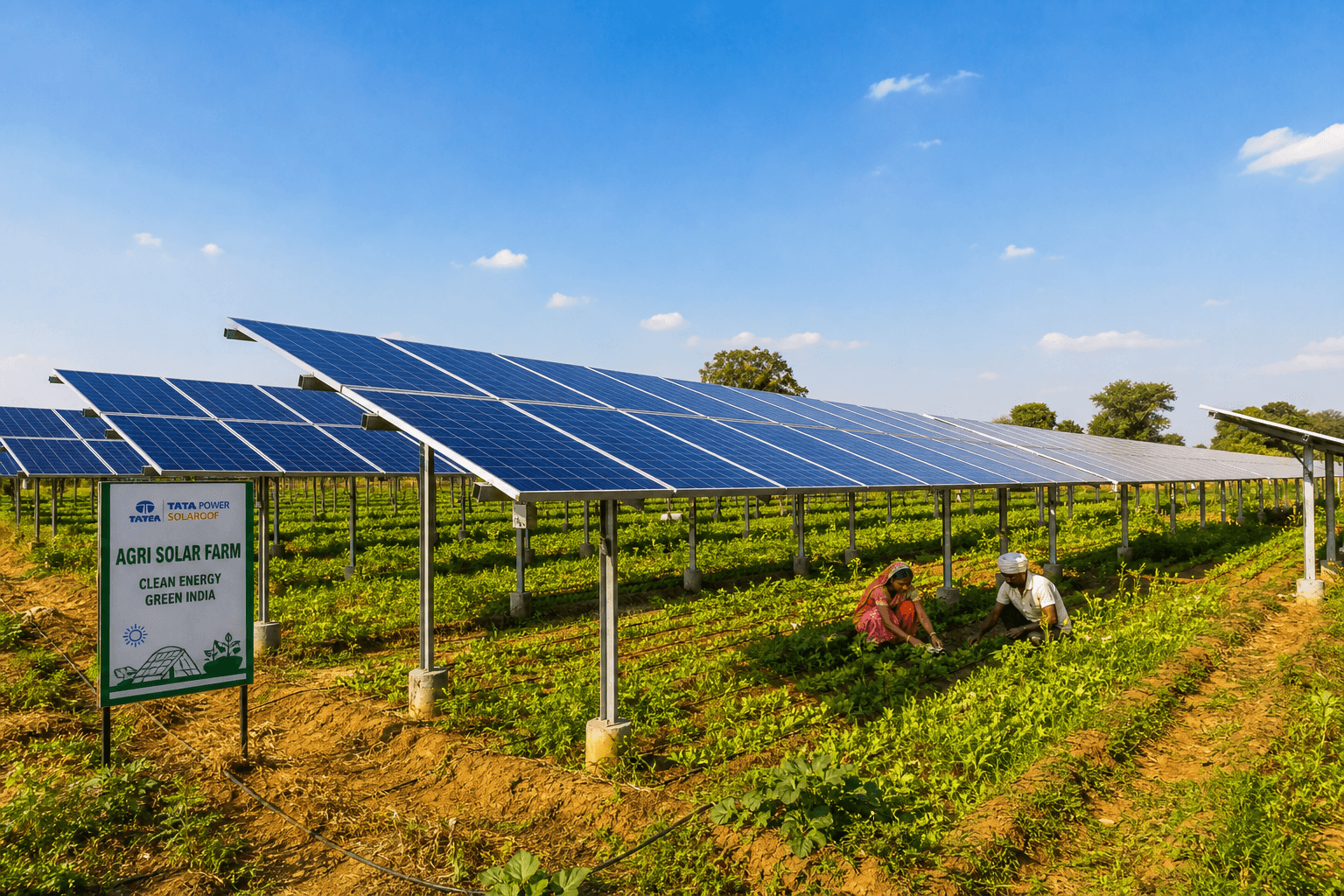
Rajasthan is India’s solar powerhouse — and in 2026, that title comes with a painful footnote: curtailment. Trade press (Mercom India, Economic Times, The Hindu business pages) has reported that since January 2026, roughly 11.5 GW of renewable capacity in the state faced forced backing down, with peak shutdowns above 4 GW on some days. If you lease farm land, hold an open-access stake, or plan PM-KUSUM Component A, this is not a distant grid topic — it is your rent and ROI.
This article explains why shutdowns happen, what T-GNA means in plain language, and how farmers should protect themselves in contracts. Numbers are indicative from industry reporting — not verified government totals. Always read your lease/PPA and consult a local advocate for legal advice.
Disclaimer on data: Curtailment GW figures come from industry media (Mercom, ET, Hindu BusinessLine-style coverage, 2026). MNRE/state utilities may publish different aggregates. Use this article for risk awareness, not as a legal claim against any agency.
What is curtailment — in one minute?
Curtailment means a solar or wind plant is told to reduce or stop export to the grid even when the resource is available (bright sun, strong wind).
Reasons in Rajasthan’s 2026 story cluster around:
- Transmission congestion — more RE built than lines can carry at peak
- Scheduling / market rules — T-GNA and merit-order dispatch
- State load patterns — surplus solar at midday, limited demand or storage
- Interstate corridor limits — power cannot always reach buyers outside Rajasthan
For a farmer, the symptom is indirect: developer pays late, generation-linked lease underperforms, or open-access bill credits shrink.
The ~11.5 GW headline since January 2026
Mercom India and similar outlets (May–June 2026) reported cumulative curtailment affecting on the order of 11.5 GW of Rajasthan RE capacity since the start of 2026, with single-day peaks where more than 4 GW was backed down.
How to read that number:
| Point | Meaning |
|---|---|
| GW affected | Not necessarily “11.5 GW permanently off” — often cumulative event volume or capacity exposed to curtailment events (wording varies by article) |
| Peak >4 GW | Shows severity on sunny days — the worst hours for solar revenue |
| Since Jan 2026 | Policy and grid stress intensified after rapid RE build-out |
Verify: cross-check any investment deck against latest Mercom/ET stories and Rajasthan DISCOM / SLDC notices if available.
Transmission: ~23 GW RE vs ~18.9 GW evacuation (press narrative)
A recurring theme in Economic Times and Mercom-style analysis:
- Rajasthan’s installed renewable capacity is cited near 23 GW
- Transmission capacity to evacuate it is cited nearer ~18.9 GW
- The ~4+ GW gap shows up as curtailment during peak solar hours
Analogy for farmers: you built a canal wider than the outlet pipe — water (power) pools upstream until the system says stop flowing.
That is why new transmission lines and storage are policy priorities — but timelines are years, while your lease may start now.
What is T-GNA — without the jargon trap?
T-GNA (Transmission–Grid Connectivity and General Network Access) is part of how generators get rights to inject power on shared interstate infrastructure.
Farmer-level takeaway:
- Developers schedule generation in market / SLDC systems
- When corridors are full, solar is curtailed first in some merit stacks because it is variable and zero marginal cost — policy fights continue
- PPA “must-run” status for RE is not always fully honoured in practice — disputes land in courts and regulatory commissions
If a land broker says “sunshine guaranteed income,” ask: guaranteed by whom — PPA, SLDC, or WhatsApp?
Impact by farmer situation
Land leased for utility-scale solar
- Rent may be fixed per acre (safer) or tied to generation (riskier in curtailment years)
- Developer bankruptcy or payment delay risk rises when PLFs fall
- 25-year lease without curtailment clause review is dangerous
Open-access or group captive investors (rural entrepreneurs)
- Banked units and credits may be lower than modelled
- ALMM cost pressure (June 2026) + curtailment = double margin squeeze — see ALMM guide
PM-KUSUM Component B pump only
- Off-grid pump — no curtailment from grid (no export)
- Still the best near-term reliability play for irrigation — pump bill savings
Component A / Agri-PV dreams
- Evacuation within 5 km of substation is necessary but not sufficient — feeder congestion still matters
- Read PM-KUSUM guide and PM-KUSUM 2.0 agrivoltaics before mixing crops with large grid plants in curtailed zones
Questions to ask before signing land lease
- Fixed rent or generation-linked?
- Who bears curtailment risk — farmer, developer, or shared?
- Payment security — escrow, annual prepay, or default history of developer
- Approved evacuation / ISTS connectivity status in writing
- Exit clause if plant is stranded >X months
If irrigation is the primary goal, compare Component B 60% subsidy path with lease income — a ₹1.2–1.6 lakh pump after subsidy may beat uncertain lease cash flow. See 3HP–7HP pump costs.
Policy direction (high level)
Central and state planners talk about green energy corridors, storage tenders, and market reforms — useful, but not instant relief. Farmers should plan for 2026–27 curtailment risk as real, especially in western Rajasthan solar belts.
Bottom line
- ~11.5 GW curtailment exposure and >4 GW peak shutdowns are serious signals in 2026 press — not scare fiction
- Root cause story: too much RE, too little transmission (~23 vs ~18.9 GW narrative)
- Off-grid pumps largely insulated; land lease / open access exposed
- Read contracts; do not trust brochure PLF alone
Disclaimer: Statistics cited from Mercom India, Economic Times, The Hindu business coverage, and similar industry reporting (2026). Figures are indicative and may be revised. Ask Kisan is not a legal or investment advisor. Verify with developers, DISCOM, and qualified counsel before leasing land.
Last verified: June 2026.
Frequently asked questions
How much solar has been curtailed in Rajasthan in 2026?
Industry reporting (e.g. Mercom India, May–June 2026) cites roughly 11.5 GW of renewable capacity affected by curtailment in Rajasthan since January 2026, with peak shutdowns exceeding 4 GW on some days. Figures vary by source and week — treat as indicative, not a government ledger line.
What is T-GNA and why does it matter?
T-GNA (Transmission–Grid Connectivity and General Network Access) rules govern how generators schedule power on the interstate grid. When transmission corridors are congested, Rajasthan’s solar-rich zones may be asked to back down even when the sun is strong — hurting plant revenues and sometimes lease payments tied to generation.
Does curtailment affect PM-KUSUM farmers with solar pumps?
Standalone off-grid pumps (Component B) are not curtailed by grid operators. Farmers who leased land for large solar parks, open-access investments, or Component A style plants may see delayed payments or lower-than-modelled income if developers face shutdowns.
What is the transmission gap in Rajasthan?
Press reports often contrast installed renewable capacity (cited around 23 GW in Rajasthan) with transmission capacity available to evacuate it (figures near 18.9 GW appear in Mercom/Economic Times-style coverage). The gap forces backing down solar during peak sunshine — exactly when plants should earn most.
Should I lease my farm land for solar in Rajasthan now?
Do not sign a 25-year lease based only on headline ₹/acre rates. Ask whether the developer’s PPA allows compensation for curtailment, who bears grid risk, and whether the project has approved evacuation. Compare with pump subsidy paths under PM-KUSUM if you need reliable irrigation income.