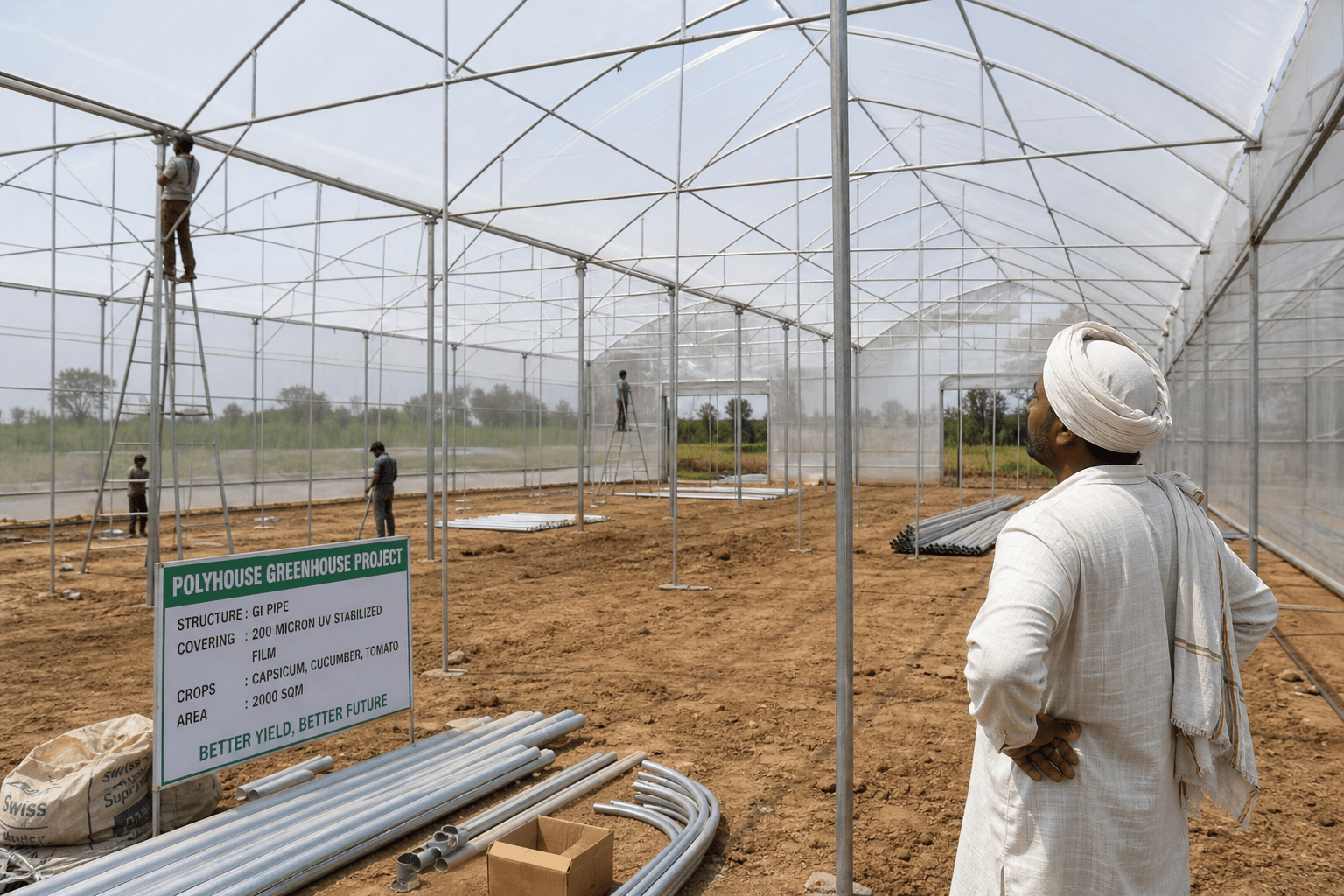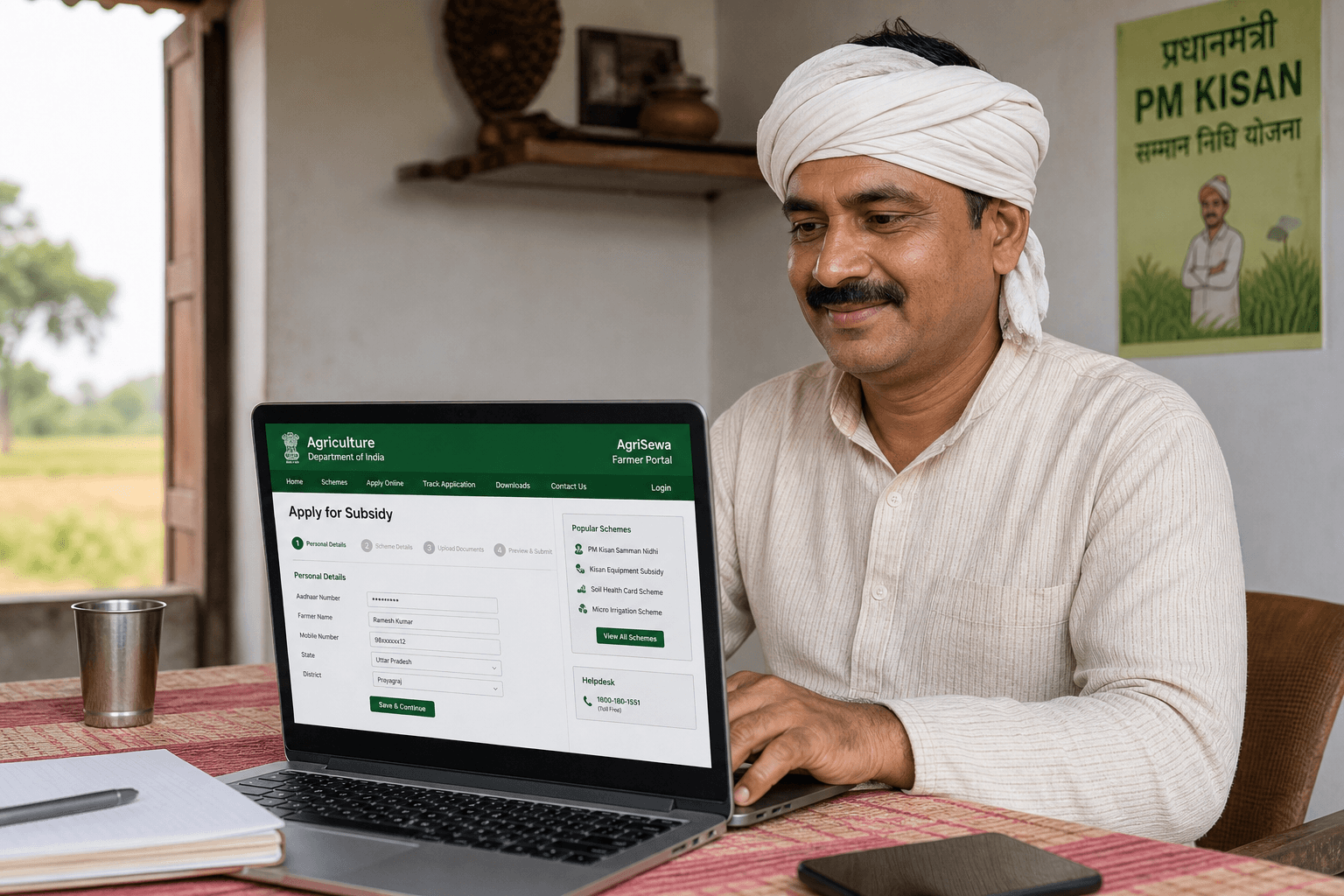
If you farm in Gujarat and search "polyhouse subsidy Gujarat kaise milegi", the answer always lands on one portal: i-Khedut at ikhedut.gujarat.gov.in. Unlike Maharashtra's lottery on MahaDBT, Gujarat often runs first-come-first-served (FCFS) windows — meaning complete files submitted early win, and late applicants find the district cap already full even when the headline rate still says 50% MIDH.
This guide walks through i-Khedut application steps, the documents you need (7/12, 8-A, bank sanction), how 50% subsidy math works against cost norms, and which crops Gujarat polyhouse growers profit from most in 2026.
Never start polyhouse construction before online approval and bank term-loan sanction. Building early permanently forfeits subsidy nationwide — Gujarat FCFS does not forgive JIT failures. Vendors who say "i-Khedut baad mein kar lena" are risking ₹10–20 lakh of your money.
Gujarat Polyhouse Subsidy at a Glance
| Item | Detail |
|---|---|
| Central baseline | 50% under MIDH/NHM protected cultivation |
| State portal | i-Khedut — ikhedut.gujarat.gov.in |
| Application style | First-come-first-served in many seasons |
| Enhanced categories | SC/ST and eligible farmers — verify current 50–90% band on portal |
| Subsidy basis | Government cost norms per sqm, not vendor invoice total |
| Credit link | Bank term loan sanction required for back-ended release |
| Max area (typical MIDH) | Up to 4,000 sqm per beneficiary — confirm circular |
Because 2026 market construction for a naturally ventilated polyhouse (NVPH) runs roughly ₹25–40 lakh per acre while norms sit at ₹844–1,060 per sqm depending on area slab, your effective subsidy is typically 35–40% of real spend — not the full advertised half. Budget 15–20% extra cash beyond bank margin. Our polyhouse subsidy master guide explains this trust gap in detail.
Before You Open i-Khedut — Prerequisites
Skipping these steps causes FCFS rejection even when you click submit first:
1. Land title clarity
- Owner: Updated 7/12 and 8-A in your name
- Lessee: Registered lease — typically 10–15+ years — matching horticulture department norms
- Plot area sufficient — some schemes expect cultivable land ≥ 2× polyhouse footprint
2. Bankable Detailed Project Report (DPR)
Your DPR must include:
- Structure type — NVPH, fan-and-pad, or shade net (₹710/sqm norm for shade net)
- Financials with DSCR ≥ 1.5
- Crop plan, yield assumptions, and market linkage
- Three vendor quotations with GST
3. Bank term-loan sanction
Approach your KCC branch or agriculture term-loan desk with the DPR. Gujarat banks routinely refinance horticulture portfolios through NABARD — you apply at the bank, not NABARD office. Sanction letter upload is mandatory on i-Khedut for credit-linked subsidy.
4. Soil and water tests
Gujarat's dark zone blocks favour water-efficient structures — drip integration under PMKSY may attract an additional 10% top-up in over-exploited areas. Note EC on water test reports; high salinity affects crop choice.
i-Khedut Portal — Step-by-Step Application
Step 1 — Register and complete farmer profile
- Visit ikhedut.gujarat.gov.in
- Click New Farmer Registration (or login if already registered for PMKSY/other schemes)
- Link Aadhaar and mobile OTP
- Fill personal details, category (general / SC / ST / small / marginal), and bank account
Step 2 — Select horticulture component
When the protected cultivation / polyhouse window is open:
- Navigate to Horticulture or Scheme Application section
- Select Polyhouse / Greenhouse / Shade Net House as per your DPR
- Enter proposed area in sqm, structure type, and district/block
Windows close without public fanfare when district allocation fills — monitor Gujarat Horticulture Department notices.
Step 3 — Upload documents
Standard i-Khedut bundle:
| Document | Purpose |
|---|---|
| 7/12 extract | Land ownership / survey proof |
| 8-A | Record of rights supplementary |
| Aadhaar, PAN | Identity |
| SC/ST certificate | Enhanced subsidy category |
| Bank term-loan sanction letter | Credit linkage |
| Vendor quotations (3) with GST | Cost verification |
| Soil + water test reports | Technical eligibility |
| DPR PDF | Project bankability |
| Passport photo | Application record |
Scan at readable resolution — blurry 8-A uploads are a top FCFS rejection reason.
Step 4 — Pay processing fee (if applicable)
Some components charge a nominal portal fee — keep payment receipt screenshot.
Step 5 — Submit and note application ID
Save the application number and timestamp. FCFS disputes are resolved on submission time, not when you first created a draft.
Step 6 — District verification
District Horticulture Officer (DHO) or block agriculture officer verifies land, documents, and alignment with approved DPR. Field visit may follow.
Step 7 — Approval letter before construction
Receive written permission / sanction on portal or official letter. Begin erection only after this and bank disbursement schedule clarity.
Step 8 — Build, inspect, subsidy credit
Construct exactly as approved:
- Materials — B-Class GI, approved UV polyfilm micron
- Area slab matching subsidy norm tier
- Approved crop planted — book certified tissue-culture seedlings 3–4 months ahead
After Joint Inspection Team (JIT) or state-equivalent verification, back-ended subsidy (typically 50% of eligible norm cost) credits to your loan account. Effective relief on total project cost remains 35–40% for most farmers.
Bank Loan Process in Gujarat — Practical Notes
- Carry 7/12, 8-A, Aadhaar, DPR, quotations to agriculture branch
- Ask for horticulture term loan linked to MIDH/NHB — mention i-Khedut application
- Expect 75–90% project finance with 10–25% promoter margin
- Stack Agriculture Infrastructure Fund (AIF) registration where eligible for 3% interest subvention for seven years on the term loan
- Maintain clean KCC repayment — strengthens sanction speed
Read NABARD loan process for how refinancing works behind the counter.
Popular Crops for Gujarat Polyhouses
Gujarat's climate and mandi links favour:
| Crop | Why growers choose it |
|---|---|
| Coloured capsicum | Strong mandi and export demand; net benchmarks ₹15–18 lakh/acre/year in well-managed NVPH |
| Cucumber (seedless) | Multiple cycles; fits FCFS quick-payback starter units |
| Tomato | Year-round price volatility — contract farming preferred |
| Rose / gerbera | Floriculture clusters near urban markets |
| Bitter gourd, sponge gourd | Regional off-season premium |
Crop without buyer = subsidy without profit. Secure verbal or written offtake before ordering seedlings. Low-value crops in hi-tech fan-and-pad houses fail DSCR even at 50% subsidy.
Gujarat-Specific Tips for 2026
- Apply early in window — FCFS favours first complete file, not first phone call to vendor
- Dark zone blocks — highlight water-saving drip in DPR; see PMKSY drip guide
- Compare NHB route — commercial 4,000 sqm projects may also use nhb.gov.in if state cap is full — different fee and inspection path
- Geo-tagged photos at foundation, frame, and covering stages — essential for dispute resolution
- Avoid DPR deviation — changing capsicum to cucumber without written permission triggers rejection
Common Mistakes on i-Khedut
- Construction before portal approval
- Missing 8-A while only uploading 7/12
- Term loan sanction date after backdated vendor invoice
- Trusting dealer's 50% of full quote — norm maths ignored
- Unregistered lease for non-owner applicants
- Server rush hour on last day — submit off-peak with complete PDFs
Cross-check our 9 subsidy mistakes guide.
Timelines You Should Plan For
| Phase | Duration (typical) |
|---|---|
| DPR + bank sanction | 1–3 months |
| i-Khedut apply + DHO verify | 1–2 months |
| Construction | 2–4 months |
| Inspection + subsidy credit | 1–3 months |
| Total | 9–14 months from zero to subsidy in loan account |
Cash flow plan must cover promoter margin + running costs until Year 1 harvest — target ₹4–6 lakh/year operating cost for a 4,000 sqm unit.
Where to Verify Live Rules
- i-Khedut: ikhedut.gujarat.gov.in
- Gujarat Horticulture / Agriculture department — official .gov.in circulars
- NHB (if parallel commercial route): nhb.gov.in
- Bank sanction letter — your binding finance terms
Compare other states in our state-wise polyhouse guide.
The Bottom Line
Gujarat polyhouse subsidy in 2026 flows through i-Khedut, rewards early complete applications, and still follows national apply-before-build discipline. Assemble 7/12, 8-A, bank term-loan sanction, and bankable DPR before the window opens, choose capsicum, cucumber, or floriculture with a buyer lined up, and treat 50% MIDH as 35–40% effective on real bills. That honesty keeps your project bankable after the subsidy cheque lands.
Disclaimer: Subsidy percentages, FCFS windows, district caps, and document lists change with Gujarat budget cycles and MIDH funding. Verify every figure on ikhedut.gujarat.gov.in and your district horticulture office before investing. Ask Kisan is not a government portal or bank.
Last verified: 10 July 2026.
Frequently asked questions
What is the polyhouse subsidy percentage in Gujarat in 2026?
The central MIDH/NHM baseline is 50% on approved cost norms for protected cultivation. Gujarat may offer enhanced rates up to 50–90% depending on farmer category — SC/ST and eligible small farmers often receive higher shares. Subsidy is calculated on government cost norms per sqm, not full vendor quotes, so effective support is typically 35–40% of actual spend.
How do I apply for polyhouse subsidy on i-Khedut?
Register on ikhedut.gujarat.gov.in, complete farmer profile with Aadhaar and land details, select the horticulture or protected cultivation component when the window is open, upload 7/12 and 8-A, bank passbook, quotations, soil/water reports, and bank term-loan sanction letter. Submit before starting construction — Gujarat runs first-come-first-served in many seasons.
Which land documents does Gujarat require for polyhouse subsidy?
Standard set includes 7/12 extract (satbara), 8-A record, Aadhaar, PAN, caste certificate if claiming SC/ST enhanced rate, registered lease deed if not owner (typically 10+ years), and geo-coordinates matching the plot. District horticulture officer verification follows online submission.
Is bank loan mandatory for Gujarat polyhouse subsidy?
Yes for credit-linked MIDH/NHB-style routes. Secure bank term-loan sanction for the project before or alongside i-Khedut application. Back-ended subsidy credits to the loan account after inspection. Self-funding without sanctioned credit usually disqualifies the credit-linked component.
Which crops are most profitable in Gujarat polyhouses?
Coloured capsicum, cucumber, tomato, and floriculture (rose, gerbera) dominate Gujarat horticulture clusters. Naturally ventilated polyhouses near Ahmedabad, Vadodara, and South Gujarat target mandi and export-grade produce. Match crop to market linkage before planting — subsidy does not guarantee offtake.