If you searched "PMKSY drip subsidy 2026 kitni hai" or "per drop more crop apply kaise karein", you are looking at one of the most practical subsidies in Indian farming — and one that changed little in headline rates but a lot in state portal windows, vendor empanelment, and stacking rules with polyhouse projects.
This July 2026 update focuses on what is new in application practice, reaffirms the 55% / 45% central split for micro-irrigation, and explains why drip under PMKSY should sit before protected cultivation in most farm plans. For fertigation design, water savings data, and document checklists, our full guide remains the reference: Drip Irrigation & Fertigation Subsidy under PMKSY.
What Per Drop More Crop Covers in 2026
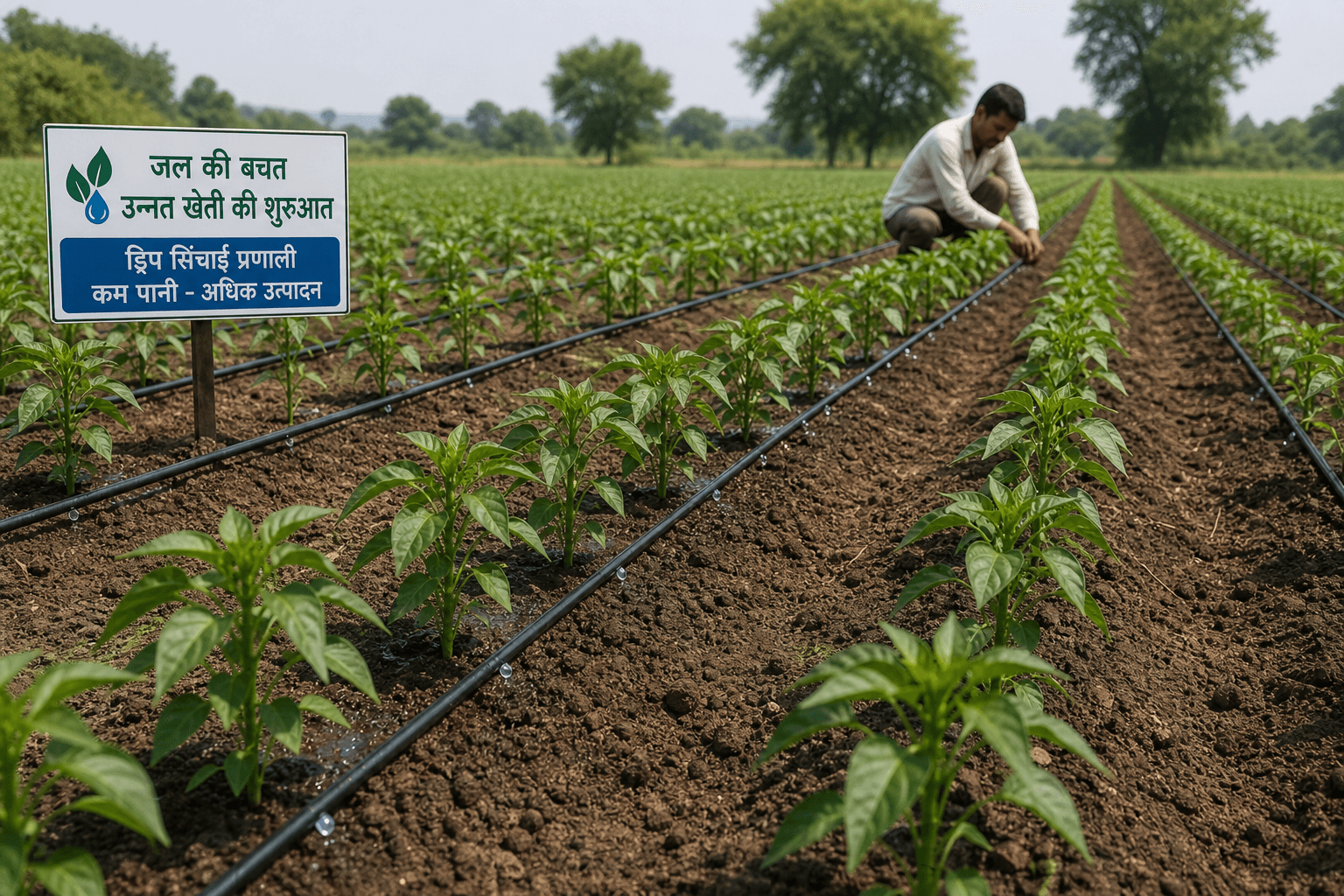
Pradhan Mantri Krishi Sinchayee Yojana (PMKSY) has three broad thrusts: accelerate irrigation coverage, improve on-farm water efficiency, and expand micro-irrigation. The Per Drop More Crop (PDMC) sub-scheme is the one farmers use for drip and sprinkler systems.
Eligible micro-irrigation typically includes:
- Drip sets — main line, sub-mains, laterals, inline or online emitters
- Sprinkler systems — portable or semi-permanent, as per state norms
- Filtration and fertigation — disc/screen filters, venturi injectors, fertiliser tanks where the approved package includes them
- Pipeline and accessories — PVC/HDPE as per technical specifications on the state portal
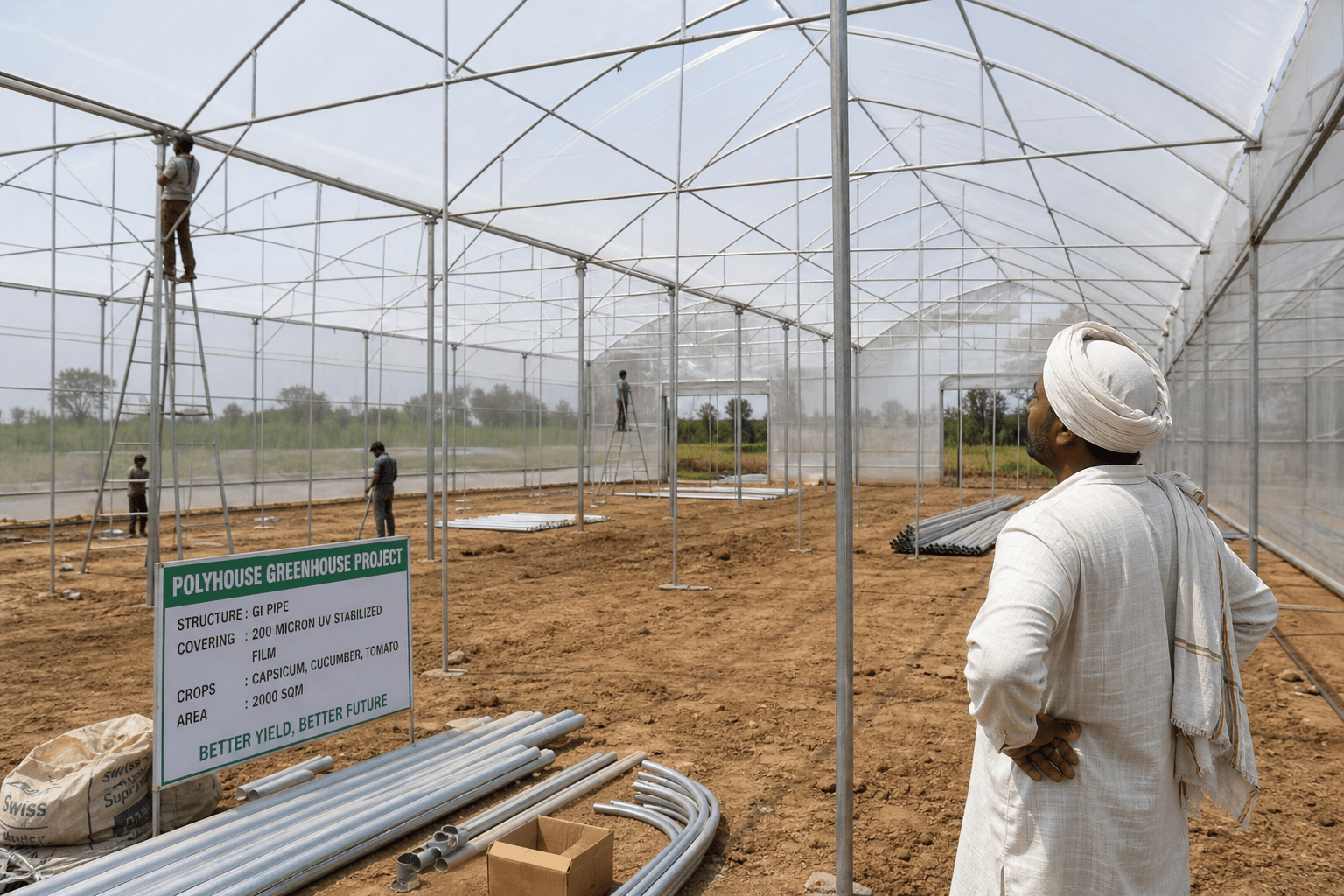
PMKSY does not replace a polyhouse subsidy. It funds precision water delivery on open field or inside structures when claimed as a separate, eligible component. That distinction matters when your NHB DPR already lists drip — you cannot claim the same line item twice.
Central rates (55% small/marginal, 45% others) are stable in policy language, but state top-ups and open windows change every season. Treat every figure here as planning guidance. Before paying a dealer advance, verify live rates on your state PMKSY portal and district agriculture or horticulture office.
Subsidy Rates — Central Share and State Top-Ups
The 2026 baseline under PDMC remains category-based:
| Farmer category | Central support (indicative) |
|---|---|
| Small and marginal farmers | 55% |
| Other farmers | 45% |
States add top-ups on the farmer's remaining share or on total project cost, depending on state rules. Indicative examples frequently cited in programme summaries:
- Uttar Pradesh — up to 90% combined for small farmers; 65–80% for others in many seasons
- Gujarat (i-Khedut) — additional +10% in dark zones for water conservation priority
- Rajasthan (RajKisan) — 60% support on pipelines combined with central share in many windows
- General range nationwide — 60–90% effective support when state budget aligns
Lottery states (Madhya Pradesh, Rajasthan in many cycles) publish beneficiary lists after the window closes. Early application within the announced dates improves odds when demand exceeds allocation.
State PMKSY Portals — Where to Apply
There is no single national drip application website. Each state runs its own PMKSY / micro-irrigation portal tied to DBT release after inspection.
Common portals farmers use:
| State | Portal / route |
|---|---|
| Madhya Pradesh | MPFSTS — mpfsts.mp.gov.in |
| Gujarat | i-Khedut — ikhedut.gujarat.gov.in |
| Rajasthan | RajKisan / state agriculture portal |
| Uttar Pradesh | uphorticulture.gov.in |
| Maharashtra | Mahagov / horticulture micro-irrigation module |
| Karnataka | Raitha Samparka / horticulture schemes |
Typical application flow:
- Register with Aadhaar-linked mobile
- Upload land records — 7/12, 8-A, Jamabandi, Khasra-Khatauni as applicable
- Select system from empaneled vendor list if required
- Link bank account for subsidy DBT
- Track inspection and release status online
Some states require prior sanction before purchase; others release subsidy after joint inspection. Confirm your state's sequence — buying equipment before approval is a top rejection reason.
Pairing PMKSY Drip with Polyhouse and Solar
The highest-return sequence for many small farmers:
- PMKSY drip + fertigation on open field — lowest capital, fastest water and input savings
- PM-KUSUM solar pump — removes diesel cost; pairs naturally with drip pressure management
- NHB/MIDH polyhouse — protected cultivation with drip already understood operationally
When you write a polyhouse DPR, drip specifications (B-Class GI where required, UV-stable components, integrated fertigation) appear in the technical section. Subsidy for the structure flows through NHB; field-scale drip on open land flows through PMKSY. Inside the polyhouse, irrigation may be bundled in the horticulture component — do not duplicate claims on the same invoice line.
For polyhouse paperwork, see our polyhouse subsidy guide for 2026. For the full scheme landscape, see Government Farming Subsidy Schemes 2026 — Complete List.
Documents and Common Rejection Reasons
Keep ready before opening the portal:
- Aadhaar card
- Land ownership or registered lease deed
- Aadhaar-seeded bank passbook for DBT
- Caste certificate if applying under SC/ST enhanced categories where offered
- Vendor quotation with GST if required at application stage
- Soil/water test — useful for emitter spacing and fertigation planning
Rejection triggers we see repeatedly:
- Non-empaneled vendor quotations
- Equipment purchased before sanction where prior approval is mandatory
- Undersized filtration leading to failed inspection or clogged emitters within a season
- Missing application window — lottery lists are not reopened for late forms
- Area above 5 hectare ceiling per beneficiary without splitting eligible holdings correctly under state rules
Economics — Why 55% Matters Even Without Polyhouse
Government programme materials cite roughly 70% water savings, 40% fertiliser savings, and 20–30% yield improvement with well-managed drip versus flood irrigation. Payback often lands in one to two seasons from input savings alone.
As a planning figure, a field-scale drip system on one acre may cost a few lakh rupees before subsidy. After 55% central support plus state top-ups, farmer share can drop sharply — in UP, small farmers have seen effective rates near 90% combined, meaning roughly 10% farmer contribution when the window and category align.
That makes PDMC one of the best first modern-farming investments — lower risk than polyhouse, simpler paperwork than multi-component fisheries projects, and immediate impact on water bills.
2026 Practical Checklist
Before you sign a vendor contract:
- Confirm open window dates on the state PMKSY portal
- Verify empaneled dealer list and model specifications
- Match farmer category (small/marginal certificate if enhanced rate applies)
- Plan emitter layout for your crop — orchard spacing differs from vegetable beds
- Include proper filtration for your water quality
- Read the full technical guide: Drip Irrigation & Fertigation under PMKSY
Every cost, percentage, and portal URL in this article should be confirmed on official government websites — state horticulture portals, agriculture department notices, and your district office — before you dig trenches or pay advance.
Disclaimer: Subsidy windows, lottery results, and top-up percentages change by state budget cycle. Figures are indicative for planning, not guarantees. Ask Kisan is not a government agency or irrigation vendor.
Frequently asked questions
What is the PMKSY drip subsidy rate in 2026 for small and marginal farmers?
Under the Per Drop More Crop component, central support is 55% for small and marginal farmers and 45% for other farmers on eligible micro-irrigation systems. Many states add top-ups that can push the effective benefit to 60–90%. Confirm the live percentage on your state PMKSY or horticulture portal before ordering equipment.
Where do I apply for PMKSY drip subsidy — is there one national website?
No. Applications go through your state PMKSY or micro-irrigation portal — for example MPFSTS in Madhya Pradesh, i-Khedut in Gujarat, RajKisan in Rajasthan, or uphorticulture.gov.in in Uttar Pradesh. Register with Aadhaar, upload land records, and link a bank account for DBT.
What micro-irrigation systems qualify under Per Drop More Crop?
Eligible components typically include drip irrigation sets (main/sub-main lines, laterals, emitters), sprinkler systems, filters, fertigation units where included in the approved package, and related pipeline infrastructure as per state technical specifications and empaneled vendor lists.
Can I get PMKSY drip subsidy on the same land twice?
The area ceiling is 5 hectares per beneficiary. The same land becomes eligible again after 7 years for a fresh application — useful if you are upgrading from a basic drip set to automated fertigation. State rules on upgrades vary; check your portal.
Does PMKSY drip subsidy work with polyhouse or NHB schemes?
Yes, when components are not double-claimed. PMKSY covers micro-irrigation hardware; NHB/MIDH covers the polyhouse structure. Drip inside a polyhouse is often part of the DPR but subsidised under the horticulture component. Pair drip first on open field, then scale — see our drip irrigation master guide.