You installed on-grid solar expecting 24×7 free power. First village feeder cut, everything goes dark — inverter off, pump dead, fans still. Anger turns on the vendor: “Solar bekaar hai.” Actually, the system did exactly what Indian grid rules require: anti-islanding shutdown during outage.
This guide explains why grid-tied solar stops in power cuts, when standard on-grid is still the right choice, and when hybrid (solar + battery) or standalone solar pump is better for irrigation when DISCOM supply fails.
Pair with on-grid solar 5 mistakes and PM-KUSUM pump guide.
Never bypass anti-islanding to keep panels running in a blackout. It endangers linemen, violates net-metering agreement, and can void insurance and subsidy.
What happens in a power cut — second by second
Normal on-grid day:
- Solar inverter converts DC → AC
- Power feeds home/farm load first
- Excess exports to DISCOM via net meter
When grid fails:
- Inverter detects grid voltage/frequency loss
- Anti-islanding relay trips within ~2 seconds (often faster)
- Inverter stops exporting AND stops powering load in standard grid-tie mode
- Panels may still generate DC — nowhere safe to send it
Farmer perception: “Cut mein solar bhi band.” Correct — by design.
Anti-islanding — why government mandates it
Imagine maintenance staff repairing a 11 kV line they believe is dead. Your rooftop solar back-feeds the line → fatal shock risk.
Anti-islanding ensures solar cannot create an island of live power when grid is off.
| Stakeholder | Need |
|---|---|
| DISCOM lineman | Dead lines during repair |
| Regulator | Grid code compliance |
| You | Legal operation, subsidy retention |
Inverters sold for net metering must meet BIS / IEC categories with island detection. Cheap non-compliant inverters are a safety and legal risk.
On-grid is still best when…
Standard grid-tied rooftop wins on cost per watt if:
- Outages are short or rare in your feeder
- Irrigation runs mainly daytime via standalone solar pump (Component B) — separate from rooftop
- You optimize bill savings, not backup minutes
- ALMM-compliant hardware qualifies for PM Surya Ghar or state subsidy
Math: Battery adds ₹40,000–1,50,000+ per usable kWh depending on chemistry and cycle life. Payback extends 2–4 years vs plain on-grid.
If your pain is bill, not backup, do not overspend on batteries.
When hybrid is better for farm irrigation
Hybrid inverter connects solar + battery + grid:
- Grid up: works like net metering / self-consumption
- Grid down: draws from battery (and sometimes limited solar) to critical loads
- Anti-islanding still applies to grid port — but battery circuit can feed selected loads if wired as backup output
Hybrid makes sense when:
- Frequent long outages (rural feeders, storm season)
- Livestock water or drip must run fixed hours regardless of grid
- Cold store or milking machine cannot wait
- You already face diesel generator cost ₹80+/hour — battery competes with diesel, not with plain solar
Size backup for critical load only — not whole farm mansion AC.
Illustrative load prioritization
| Priority | Load | Backup note |
|---|---|---|
| 1 | 1 HP bore / drip pump | Sized battery for 2–4 hours |
| 2 | Home lights + fan | Small kWh |
| 3 | Cold store compressor | Heavy — often needs generator + hybrid |
| 4 | Thresher / mill | Usually not on battery backup |
Three farm solar architectures compared
| Type | Power cut behaviour | Best for |
|---|---|---|
| On-grid rooftop | Shuts down | Bill savings, export credit |
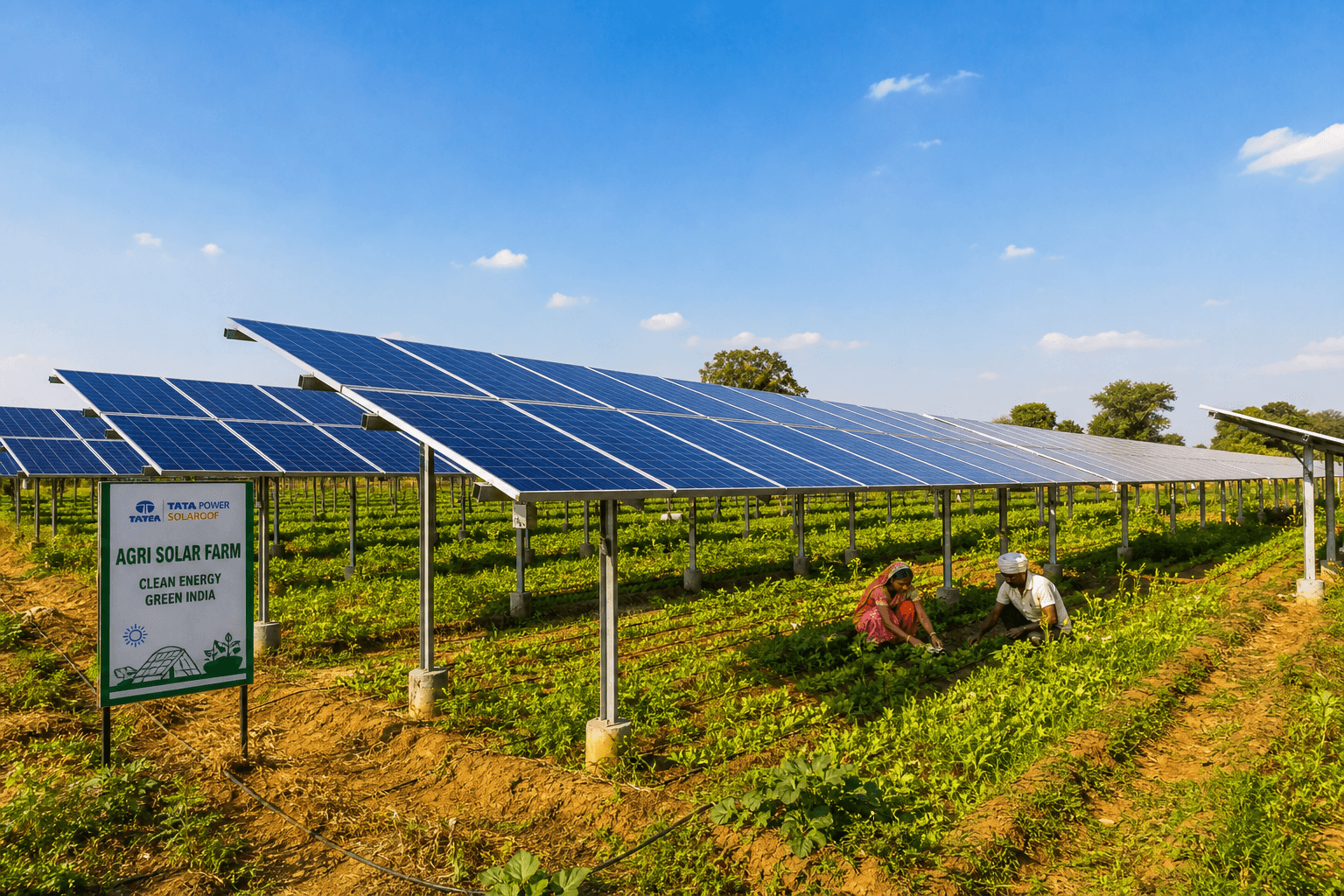
| Standalone solar pump (PM-KUSUM B) | Runs in sun without grid | Day irrigation, no grid needed |
| Hybrid + battery | Backup subset | Critical loads in outage |
| Off-grid only | Independent | Remote bore, no DISCOM line |
Many Rajasthan/Gujarat farms use Component B pump for day water + on-grid for house — solves irrigation in cut if sun is out, without whole-farm battery.
Component C and export during grid failure
Grid-connected solarised pump (Component C) also stops exporting when grid fails — same anti-islanding. Surplus needs live grid. During cut, plan stored water or diesel backup unless you add separate standalone irrigation solar.
Read solar pump savings guide — night grid use is separate from outage issue.
ALMM, subsidy, and hybrid hardware in 2026
From 1 June 2026, many net-metering projects need ALMM List-I modules and List-II cells — see ALMM List-II guide.
Hybrid inverters and batteries must appear on empanelled / ALMM lists where subsidy applies. Non-listed battery kits may get no PM Surya Ghar benefit.
Ask vendor:
- Is inverter grid-tie, hybrid, or off-grid?
- Backup port watt limit?
- Battery chemistry (LFP preferred for cycle life)?
- Warranty on battery years vs cycles?
Practical decision tree
Power cut problem?
├─ Only need irrigation in daytime sun
│   └─ PM-KUSUM standalone solar pump (Component B)
├─ Need house + pump in short outages (1–3 hr)
│   └─ Hybrid with right-sized LFP battery
├─ Need whole farm including heavy motors
│   └─ Generator + professional interlock OR separate circuits
└─ Main goal is lower bill, outages rare
    └─ Standard on-grid (accept shutdown in cut)
Installation mistakes specific to hybrid farms
- Whole-panel backup promise — inverter backup rating lower than marketing
- Neutral wiring errors — hybrid needs proper earthing
- Pump on backup without soft start — trips inverter
- Illegal manual changeover bypassing anti-islanding
- Undersized battery — dies in one cloudy outage day
Use DISCOM-approved installer familiar with Rajasthan / your state net-metering plus backup wiring.
Store tank water when sun pumps — cheapest “battery” for irrigation. Fill overhead tank 11 AM–3 PM; irrigate evening by gravity without grid or battery.
PM Surya Ghar rooftop vs farm pump — do not mix problems
PM Surya Ghar targets domestic rooftop net metering — shuts down in outage like any grid-tie system. PM-KUSUM Component B pump is a separate circuit that can run in sunlight without grid.
Farmers confuse the two: house rooftop off in cut but pump could still run if standalone solar pump exists. Solution is often second system, not one inverter doing everything.
| System | Outage behaviour |
|---|---|
| Rooftop net metering | Off (anti-islanding) |
| Standalone solar pump | Runs in sun |
| Hybrid rooftop | Backup loads only if wired |
Plan two quotes if you need both bill savings and irrigation resilience.
Battery sizing example (illustrative only)
Critical load: 1.5 kW bore pump, 2 hours during outage = 3 kWh energy need.
With LFP battery 90% usable depth and one cloudy day margin, you might specify 5–7 kWh nameplate — verify with installer load test.
Cost may land ₹80,000–1,40,000 for battery + hybrid inverter premium over plain on-grid — compare to 5 years of diesel at your current hours.
Subsidy rarely covers full battery stack under basic PM Surya Ghar tiers — budget farmer share accordingly.
Bottom line
On-grid solar during power cut must shut down — anti-islanding protects linemen and your legal standing. That is not cheating; it is grid-tie physics and law.
If irrigation when grid is down is non-negotiable, choose standalone solar pump, hybrid battery for critical loads, or water storage — not anger at standard net-metering inverter.
Match architecture to problem: bill savings → on-grid; sun-hour irrigation → PM-KUSUM pump; outage resilience → hybrid with honest load list.
Disclaimer: Grid codes, inverter standards, and subsidy lists change. Verify with DISCOM and mnre.gov.in before purchase. Ask Kisan is not a government agency or electrical contractor.
Last verified: June 2026.
Frequently asked questions
Why does my on-grid solar stop working during a power cut?
Grid-tied inverters use anti-islanding protection. When the DISCOM grid fails, the inverter shuts down within milliseconds so it does not back-feed live lines and electrocute linemen. This is mandatory safety — not a product defect. Your panels produce no usable home power in standard on-grid mode during outage.
What is anti-islanding?
Anti-islanding detects grid absence and disconnects the solar inverter from both grid and load. Without it, solar could energize fallen cables during maintenance. Indian grid codes and DISCOM net-metering agreements require compliant inverters with islanding protection.
When is hybrid solar better for farmers?
Hybrid (solar + battery + grid) suits farms that must run irrigation, livestock water, or cold store during frequent outages — if battery cost is justified. Pure on-grid is cheaper when outages are rare and irrigation can wait for sun without grid backup at night.
Can I use a diesel generator and on-grid solar together?
Only with proper interlocking and professional design — wrong wiring risks inverter damage or lineman hazard. Many DISCOMs restrict consumer-side generation parallel to grid without approval. Consult empanelled installer and DISCOM before DIY generator tie-in.
Does PM-KUSUM cover hybrid battery systems?
Standard Component B standalone pumps run in daylight without grid. Component C addresses grid pumps with export. Battery-heavy hybrid rooftop for house + pump may fall outside basic subsidy kits — check state list and ALMM-compliant hybrid inverters on mnre.gov.in.